
On this page
- What a good capsule contains
- Before and after
- How common is the problem? Our own audit
- Where the capsule goes
- What the evidence says
- What a capsule cannot do
- A quick test
- Frequently asked questions
- How long should an answer capsule be?
- Do answer capsules help SEO?
- Should every page have one?
- Is an answer capsule the same as a featured snippet?
- Sources
This article is part of our guide: What is generative engine optimization (GEO)?
An answer capsule is a 40 to 60 word paragraph at the top of a page that answers the page's question completely, in plain sentences that still make sense when quoted alone. It names the subject, gives the answer, and adds the one condition that matters. It helps readers first, and it gives AI answers a clean passage to lift.
The answer capsule is the cheapest change on this blog's list: it costs a paragraph. It is not magic, and Google says no special format is needed for its AI features. But a page that buries its answer makes every reader, human or machine, work harder, and some will take the answer from someone else.
#What a good capsule contains
Four parts, in this order:
- The subject, named. Start with the thing, not "it" or "this", so the paragraph stands alone.
- The answer. The direct reply to the page's question.
- The condition or limit. Who it applies to, when it does not, or the main trade-off.
- One specific. A number, a date, a name or a price that makes it checkable.
Keep it between 40 and 60 words. Shorter usually drops the condition; longer usually drifts into a second idea.
#Before and after
Before:
Welcome to our guide. In today's fast-moving digital world, many businesses wonder about the best way to approach their visibility. In this article we'll explore everything you need to know.
After:
Most AI crawlers do not run JavaScript, so content that appears only after scripts load may be invisible to ChatGPT and Claude. Render your main text, prices and headings on the server. Google's Gemini is the exception: it uses Googlebot, which does render scripts.
The first tells the reader nothing and gives an assistant nothing to quote. The second answers the question, adds the exception and can be lifted whole. Both are about the same length.
#How common is the problem? Our own audit
We ran Citeroot's site health scan on our own site, citeroot.app, on 14 October 2026. Of 109 pages checked, 39 had no quotable opening paragraph and 65 had no question-style sections. No page failed a check; these were warnings, and many sat on product pages rather than articles. We are rewriting those openings as we rebuild each page, this one included.
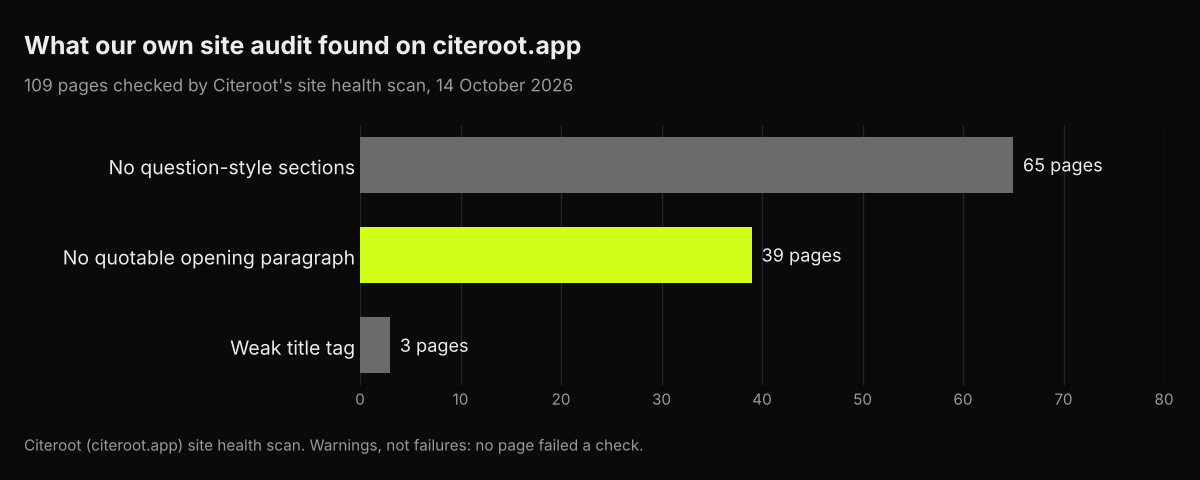
If a company that builds AI visibility software had 39 weak openings, most sites have more. Our free AEO page checker shows whether a page's opening stands alone.
#Where the capsule goes
At the very top of the main content, before any story, image caption or table of contents. If the page has an H1, the capsule is the first paragraph under it. Then repeat the pattern lower down: each section can open with one or two sentences that answer its heading before explaining.
#What the evidence says
The evidence supports the parts of a capsule, not the capsule as a format. In the GEO study (Aggarwal and colleagues, KDD 2024), adding statistics, quotations and citations to sources raised a page's visibility in AI answers by 30% to 40% on the paper's measure, while keyword stuffing did not help (arXiv). A capsule with a specific number is one place to put that evidence.
Against that, Google's guide to generative AI search says there is no special markup or structure required for its AI features, and that site owners should not rewrite content just for AI. Both points are fair. Write the capsule for the reader who wants the answer now; if it also helps an AI answer quote you, that is a bonus, not a promise.
#What a capsule cannot do
- It cannot make a page crawlable. If AI crawlers cannot read the page, see our guide to why crawlers can't read a page.
- It cannot add coverage on other sites, which drives most AI mentions.
- It cannot fix a page that answers the wrong question.
#A quick test
Copy your opening paragraph into a blank document, on its own. Then ask three questions:
- Does it name the subject without relying on the title?
- Would a stranger know the answer after reading only this?
- Is there one fact they could check?
If any answer is no, rewrite it.
#Frequently asked questions
#How long should an answer capsule be?
Between 40 and 60 words works for most questions. Enough for an answer and its main condition, short enough to quote whole.
#Do answer capsules help SEO?
They help readers, which helps every channel. Google says it needs no special format for AI features, so treat a capsule as good writing, not a ranking switch.
#Should every page have one?
Every page that answers a question should. Product and landing pages benefit too: a plain statement of what the product is, for whom and at what price.
#Is an answer capsule the same as a featured snippet?
Not quite. A featured snippet is Google's choice of passage; a capsule is the passage you write to make that choice easy, for Google and for AI assistants.
#Sources
- Aggarwal and colleagues, GEO: Generative Engine Optimization, KDD 2024.
- Google Search Central, Optimizing for generative AI search, read 24 November 2026.
- Citeroot site health scan of citeroot.app, 109 pages, 14 October 2026.