On this page
- Key takeaways
- Where the term comes from
- GEO, AEO and SEO
- What generative engines cite: our own data
- Three questions that organise the work
- 1. Can it be found?
- 2. Can it be trusted?
- 3. Can it be quoted?
- What you cannot control
- Do you need special files or markup?
- How to measure it
- A realistic first month
- Frequently asked questions
- Does GEO replace SEO?
- What is the difference between GEO and AEO?
- Can I guarantee that ChatGPT will cite my site?
- How long does GEO take to work?
- How do I get started with GEO?
- Sources
Generative engine optimization (GEO) is the work of improving how a business and its content show up in answers written by AI systems. It includes making information easy to find and use, supplying evidence an answer can rest on, and measuring whether the result is a correct, useful appearance — not just any appearance.
If a buyer asks an assistant about a problem you solve, does the answer include you, describe you correctly and send them somewhere useful? GEO is the practice of making that more likely and knowing whether it worked.
#Key takeaways
- GEO is about being named and cited inside an AI answer, where SEO is about a position in a list of links.
- It builds on SEO. Crawlable, clear, well-sourced pages are the base for both.
- Assistants answer from the pages they retrieve, so being mentioned on other sites matters as much as your own pages.
- You cannot control which pages an assistant picks or whether it cites you. You can make both more likely.
- Measure it as separate rates (named, cited, recommended) on a fixed set of questions, with ranges.
#Where the term comes from
The phrase was formalised in a 2023 research paper, GEO: Generative Engine Optimization (Aggarwal et al.), accepted at KDD 2024. The authors tested ways to change a source's visibility inside generated answers, rather than its position in a list of links, and reported improvements of up to roughly 40% on their visibility metrics in their experimental setting.
That result is useful as evidence that content choices can matter. It isn't a promise that any tactic will lift your visibility by a fixed percentage on today's live products. Treat it as a hypothesis to test against your own questions.
#GEO, AEO and SEO
Three terms get used interchangeably:
- SEO — making content discoverable and useful in search.
- AEO (answer engine optimization) — work aimed at being the source of direct answers, including featured snippets and assistant responses.
- GEO — work aimed at generative systems that compose answers from retrieved sources.
| SEO | AEO | GEO | |
|---|---|---|---|
| Where you appear | A list of links | A direct answer, such as a featured snippet | An answer an AI system writes |
| What success looks like | A high position and a click | Your passage shown as the answer | Your brand named, cited or recommended |
| What decides it | Relevance, links, page quality | A clear answer in the right place | The pages the system retrieves and what they say |
| How you measure it | Rankings, clicks | Snippets won | Share of answers that name or cite you |
They overlap heavily and aren't three independent switches. The pragmatic view: SEO fundamentals — crawlability, relevance, authority, clear pages — remain the foundation, and GEO adds new questions about what answers say and cite.
#What generative engines cite: our own data
Generative engines cite forums and video as much as company websites. We track 28 buyer questions about AI visibility tools on ChatGPT, Gemini, Google AI Overviews and Google AI Mode. In 2,778 answers over the 90 days to 21 November 2026, Reddit was cited in 638 answers (23%) and YouTube in 450 (16%). Our own site was cited in 181 (7%).
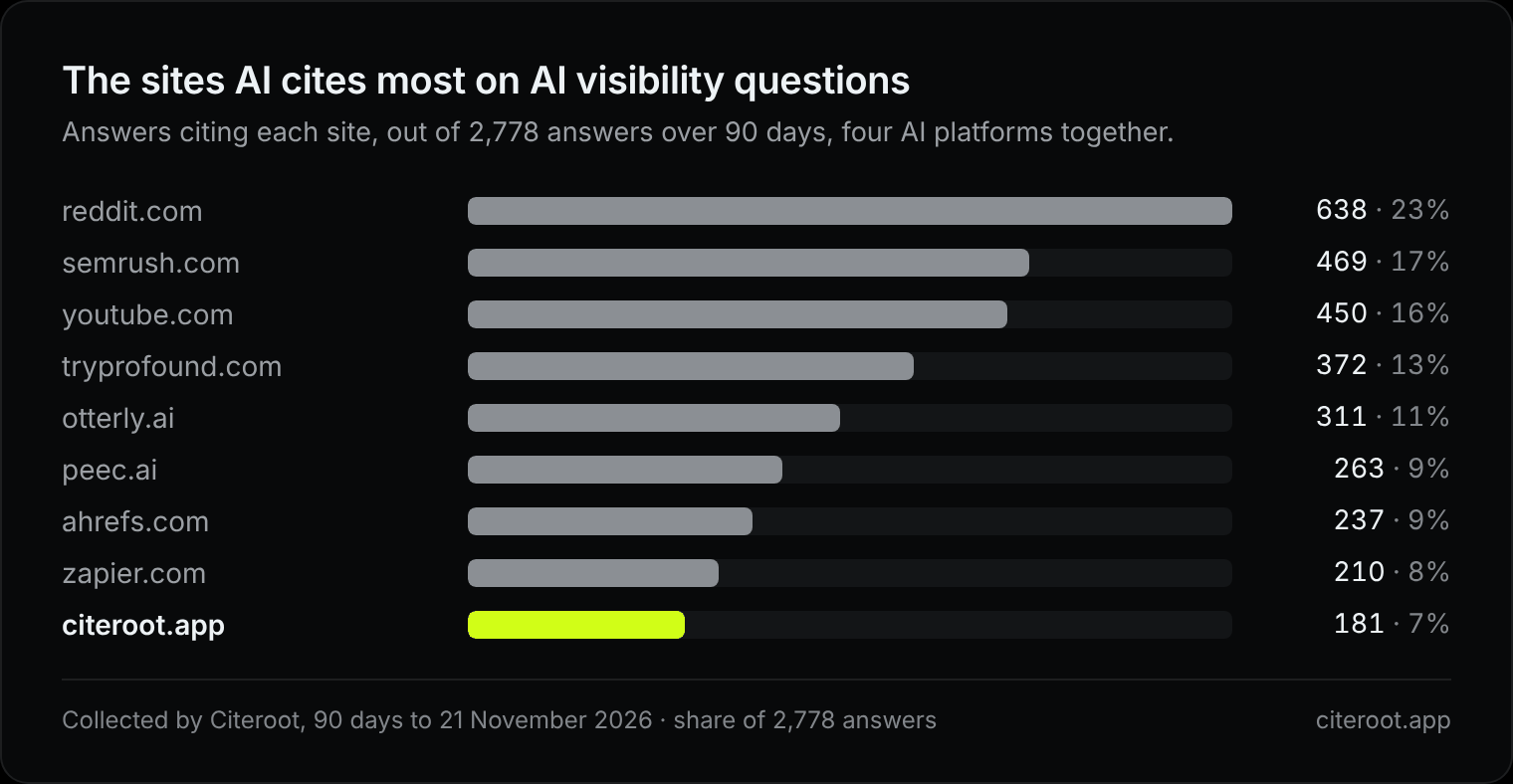
This is one topic and one set of questions, so your market will have a different list. The point it makes holds more widely: GEO work that stays on your own website misses most of the pages the answers are written from. A study of 75,000 brands by Ahrefs found the same direction for Google's AI Overviews, where brand mentions on other websites correlated with visibility (0.664) far more strongly than backlinks did (0.218) (Ahrefs). A correlation is not proof of cause.
#Three questions that organise the work
Rather than a checklist of tactics, ask three questions about each important topic.
#1. Can it be found?
Can the relevant systems reach your pages at all?
- Crawler access. Search, training and user-triggered bots are different permissions. See the AI crawler access guide.
- Indexability. Canonicals, response codes and noindex directives still apply.
- Raw HTML. Many retrieval systems read what the server returns without running scripts. Key content that appears only after JavaScript runs may never be seen.
#2. Can it be trusted?
Would an answer feel safe resting on this page?
- Specifics over adjectives. "Supports SSO via SAML, requires the Business plan" is more useful than "enterprise-ready".
- Corroboration. Claims repeated by independent sources are stronger than claims made only on your own site. Review third-party descriptions of your company and correct outdated ones through legitimate channels.
- Freshness and ownership. Dates, authors, versions and a clear owner for each page.
#3. Can it be quoted?
Could a system lift a passage and have it stay true?
- Answer-first structure. An opening paragraph that states the answer, the audience and the key limit, as in answer capsules.
- Sectioned content. Headings that match the questions people ask.
- Tables and lists with inclusions and exclusions rather than marketing summaries.
#What you cannot control
- Which pages a system chooses to retrieve for a given question.
- Whether an answer cites you even when you're retrieved. Retrieval, selection and citation are separate decisions.
- Day-to-day variance: the same prompt can return different brands on different runs.
- The product's behaviour next quarter. Documentation and behaviour change; re-check.
Be wary of anyone who promises a guaranteed citation position. A promise like that needs a defined question, surface, time and verification method to mean anything.
#Do you need special files or markup?
For Google's search experiences, Google's guidance says no special AI text files or GEO-specific markup are required. Other systems differ. llms.txt is a proposed convention that not every engine honours. Evaluate any proposed technical change against the documentation of the system you want to reach, not against a blog post's claim.
#How to measure it
Start with separate measurements rather than one unexplained score:
- Mention rate — valid answers that name the brand ÷ valid answers.
- Owned-citation rate — answers that link to your own domains ÷ valid answers.
- Recommendation rate — answers that explicitly recommend you for the prompt's use case.
- Source coverage — which independent domains and URLs appear.
- Referral outcomes — identifiable visits and conversions, measured separately.
Define the denominator, prompt set, engines, location and time window. Report failed or unavailable observations separately rather than counting them as absence. See how to measure AI visibility for a repeatable workflow.
#A realistic first month
- Week 1: baseline a fixed prompt panel for one business area.
- Week 2: separate access problems from content gaps; look at the sources.
- Week 3: ship one bounded improvement.
- Week 4: re-measure under comparable conditions and write down what happened.
The full plan has the detail. It's a workflow, not a promise that four weeks proves an effect.
#Frequently asked questions
#Does GEO replace SEO?
No. GEO builds on SEO. Keep the search fundamentals, and add measurement of what AI answers say and cite.
#What is the difference between GEO and AEO?
AEO (answer engine optimisation) aims at being the source of a direct answer, including featured snippets. GEO aims at systems that write a new answer from several retrieved pages. In practice the work overlaps and many people use the two words for the same thing.
#Can I guarantee that ChatGPT will cite my site?
No. Access and useful content do not guarantee selection for a particular answer. Anyone who promises a fixed position should say for which question, on which platform, when, and how it will be checked.
#How long does GEO take to work?
There is no evidence-backed timetable. Fixing blocked crawlers can change what an assistant is able to cite within days. Being named on other sites takes weeks or months. Set review dates around things you can observe.
#How do I get started with GEO?
Write 20 questions your buyers ask, see who AI names today, check that AI crawlers can reach your pages, and fix one gap. How to rank in ChatGPT walks through the steps.
#Sources
- Aggarwal et al., GEO: Generative Engine Optimization, KDD 2024.
- Google Search Central, Optimizing for generative AI features in Search.
- OpenAI, Overview of OpenAI crawlers.
- Perplexity, Perplexity crawlers.
- llms.txt proposal.