On this page
- Key takeaways
- How ChatGPT decides which brands to name
- What AI cited when we asked 128 times
- 8 steps to get named and cited in ChatGPT
- 1. Let OAI-SearchBot read your site
- 2. Make sure the page reads without JavaScript
- 3. Answer the question in the first paragraph
- 4. Cover the follow-up searches on the same page
- 5. Add figures, sources and quotes you can stand behind
- 6. Get named where ChatGPT already looks
- 7. Publish honest comparison pages
- 8. Measure, change one thing, measure again
- Common mistakes
- Where Citeroot stands, and what we are doing
- Frequently asked questions
- Can you pay to rank in ChatGPT?
- How long does it take to appear in ChatGPT answers?
- Does ChatGPT use Google or Bing to search?
- Is ranking in ChatGPT the same as SEO?
- How do I check if ChatGPT mentions my brand?
- Next step
To rank in ChatGPT, let its search crawler read your site, put a direct answer at the top of each page, and get your brand named on the pages ChatGPT already cites for your topic: forum threads, videos, comparison lists and official documentation. ChatGPT has no fixed ranking to climb. It searches the web, reads a few pages and names the brands those pages name.
We checked this against our own data. Below is what 128 real AI answers cited for one question, and a plain note on where our own brand stands in them: nowhere yet.
#Key takeaways
- ChatGPT has no ranking to climb. The goal is to be named and cited in its answers more often.
- It rewrites your question into several searches, so pages that answer the follow-up questions get read.
- In 128 answers we collected, the most cited source was Reddit (34%), ahead of every vendor's own site.
- A site that blocks OAI-SearchBot cannot be cited in ChatGPT search. Blocking GPTBot does not have that effect.
- Being named on other people's pages matters more than your own position for one keyword.
- Answers change from run to run, so measure rates over weeks, never a single answer.
#How ChatGPT decides which brands to name
ChatGPT names brands from two places: what it learned in training, and what it finds when it searches the web for your question. You can only influence the second one quickly.
When search is on, ChatGPT does not send your question as you typed it. OpenAI's help centre says that ChatGPT search "typically rewrites your query into one or more targeted queries" and sends those to search providers (Searching the web with ChatGPT). One question becomes several searches, and the answer is written from the pages those searches return.
We see this in the answers Citeroot collects. For the question "how to improve brand visibility in ChatGPT", the assistant ran searches such as:
- "openai official chatgpt search publishers oai-searchbot"
- "openai official guidance oai-searchbot website owners chatgpt search crawler"
- "how businesses improve product visibility in chatgpt shopping results official openai product feeds seo"
None of them is the question itself. The page that ranks for your keyword is not always the page that gets read. The pages that answer the follow-up searches are.
Answers also change from one run to the next. Ask the same question twice and the list of brands can differ, so one check tells you little. This is why the steps below end with measuring.
#What AI cited when we asked 128 times
For this question, the most cited source was Reddit, and no AI visibility vendor's own site came first. Citeroot tracks the question "how to improve brand visibility in ChatGPT" on ChatGPT, Gemini, Google AI Overviews and Google AI Mode. In 128 answers collected up to 21 November 2026, these were the sites cited most:
| Site cited | Kind of site | Answers citing it | Share of 128 |
|---|---|---|---|
| reddit.com | Forum | 43 | 34% |
| business.adobe.com | Company blog | 37 | 29% |
| youtube.com | Video | 31 | 24% |
| semrush.com | SEO tool vendor | 27 | 21% |
| help.openai.com | OpenAI help centre | 26 | 20% |
| developers.openai.com | OpenAI developer docs | 23 | 18% |
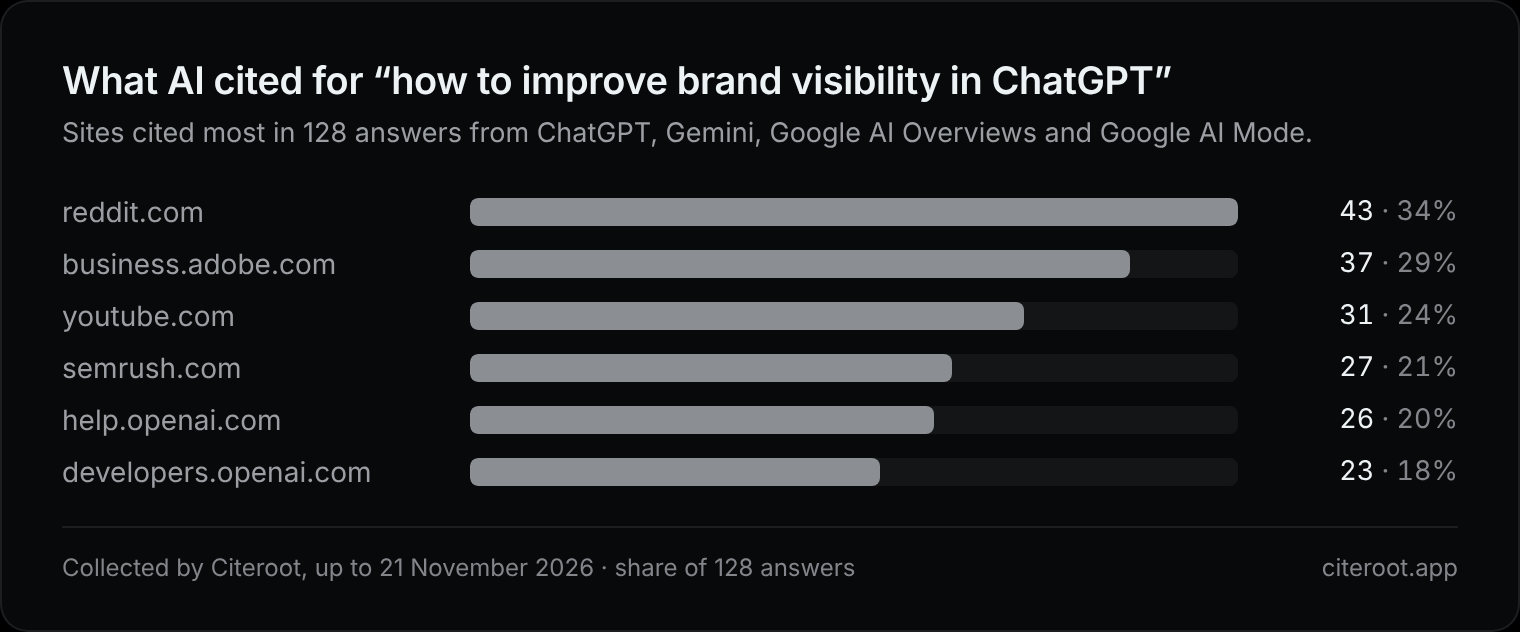
The brands those answers named most were Semrush (33 answers), Profound (14), Ahrefs (13), Peec AI (8), SE Ranking (8) and Otterly.AI (6). Citeroot was named in 0 of 128.
The same pattern holds across every question we track about AI visibility. In 2,778 answers over 90 days, Reddit was cited in 638 (23%) and YouTube in 450 (16%).
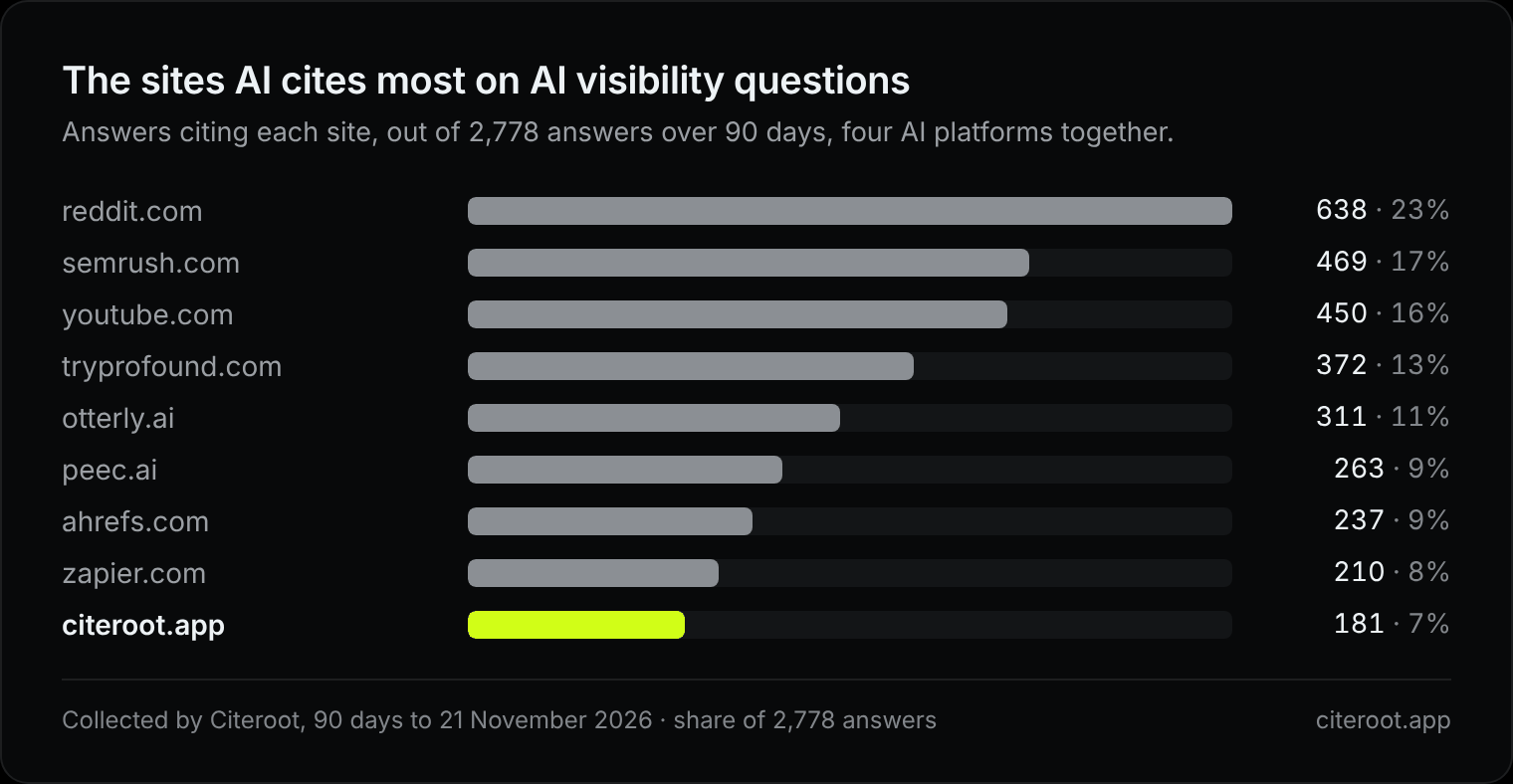
Read this with care. It is one topic, four AI platforms counted together, and a sample of answers that vary from run to run. Your market will have its own list. The method carries over even where the numbers do not: find the pages AI cites for your questions, then work on being named there.
#8 steps to get named and cited in ChatGPT
#1. Let OAI-SearchBot read your site
A site that blocks OpenAI's search crawler cannot be cited in ChatGPT search. OpenAI's documentation is direct about it: "Sites that are opted out of OAI-SearchBot will not be shown in ChatGPT search answers, though can still appear as navigational links" (Overview of OpenAI crawlers).
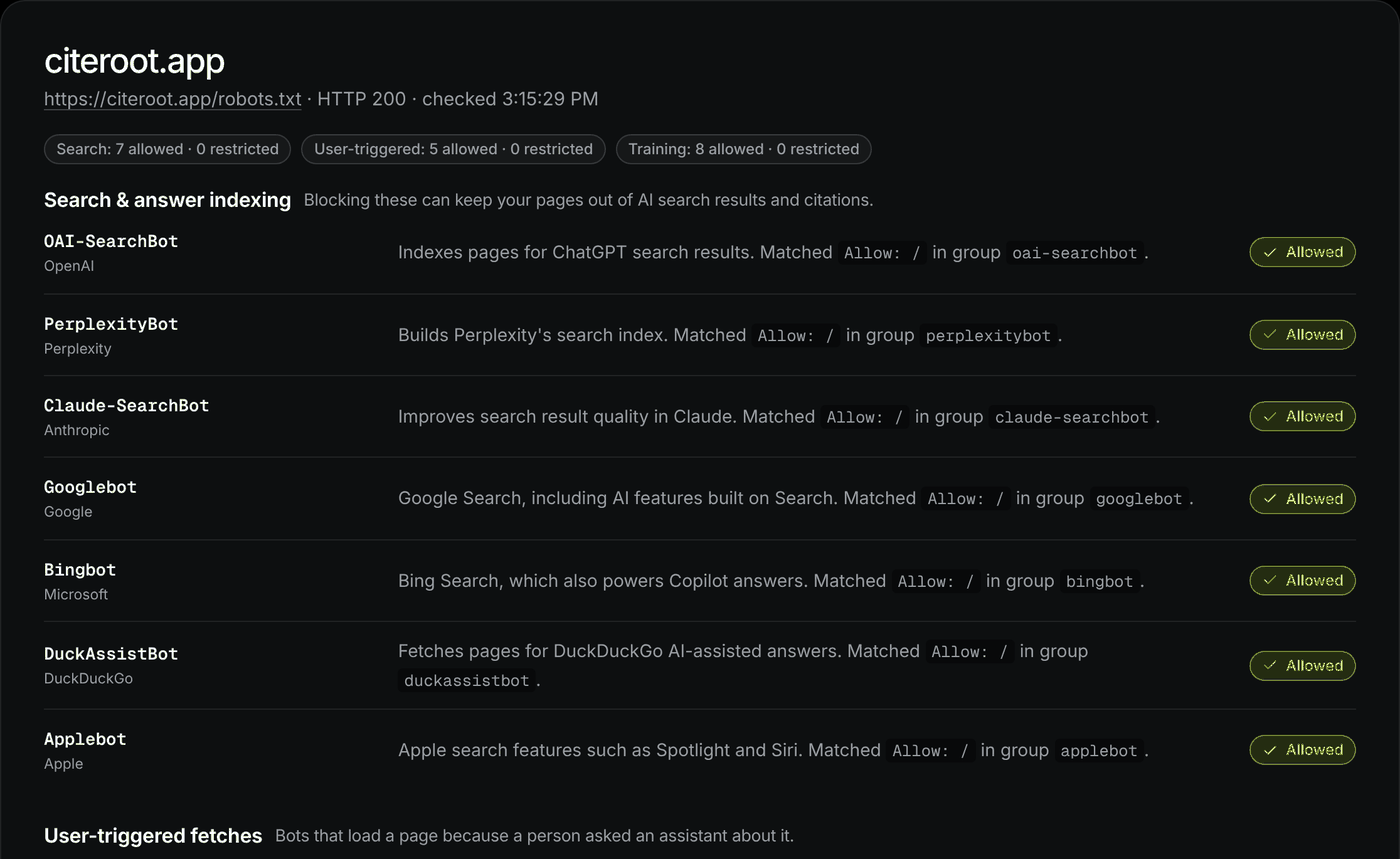
OpenAI uses separate crawlers for separate jobs. OAI-SearchBot is for search. GPTBot collects content that may be used to train models. The same page says each setting is independent, so you can allow search and refuse training. Check your robots.txt and your firewall or CDN rules, because a bot-protection rule can block a crawler that robots.txt allows. Our free AI crawler access checker tests this for 20 AI crawlers, and which AI crawlers to allow explains each one. This is its result for our own site:
#2. Make sure the page reads without JavaScript
If your main text only appears after scripts run, a crawler that does not run scripts sees an empty page. Send the full text in the HTML the server returns. To check, open the page source (not the inspector) and search for a sentence from the middle of your article.
#3. Answer the question in the first paragraph
Open each page with a 40 to 60 word answer that still makes sense when it is quoted alone. An assistant building an answer lifts passages, and a passage that starts with "it" or "this" cannot be lifted. We call this an answer capsule. Then give each section a heading that is a real follow-up question, and answer it in the section's first sentence.
#4. Cover the follow-up searches on the same page
Because ChatGPT turns one question into several searches, a page that answers only the headline question misses most of them. List the follow-ups a careful buyer would ask (price, alternatives, how it works, who it suits) and answer them on the page. Citeroot shows the searches AI actually ran for each question you track, which removes the guessing.
#5. Add figures, sources and quotes you can stand behind
Evidence makes a page more likely to be used. In the research paper that introduced generative engine optimisation, Aggarwal and co-authors tested ways of changing a page and reported that the methods could "boost visibility by up to 40% in generative engine responses", with results that varied by domain (GEO: Generative Engine Optimization, KDD 2024). Naming sources, adding statistics and adding quotations were among the methods tested.
This only works with real evidence. Use your own numbers, say where each figure comes from, and link the source. An invented statistic is a risk to your name, and people who check will find it.
#6. Get named where ChatGPT already looks
This is the step most sites skip, and our table shows why it matters: the most cited sources were a forum and a video site, not vendor homepages. A study of 75,000 brands by Ahrefs found that brand mentions on other websites had the strongest correlation with appearing in Google's AI Overviews (0.664), well above backlinks (0.218) (Ahrefs). That study is about AI Overviews, not ChatGPT, and a correlation is not proof of cause. It points the same way as our data.
In practice:
- Find the threads, videos and lists AI cites for your questions.
- Answer real questions in those forum threads as yourself, and mention your product only where it fits.
- Ask the authors of comparison lists to consider you, and give them what they need: a clear description, pricing and a way to try the product.
- Publish short videos that answer one question each.
#7. Publish honest comparison pages
Assistants are often asked "best X" and "X or Y", and they cite pages that compare. Write your own: state the criteria first, say who each option suits, and include yourself without ranking yourself first. Check every price and feature on the vendor's own page and give the date you checked. For an example of the format, see our AI visibility tools comparison.
#8. Measure, change one thing, measure again
You cannot see a ChatGPT ranking in a dashboard the way you see a Google position. What you can measure is how often you are named. Write 15 to 20 questions a buyer would ask that do not include your brand name, run them on a schedule, and record three things for each answer: whether you are named, whether your site is cited, and who is named instead. How to build a prompt panel covers the questions, and how to measure AI visibility covers the counting, with our own numbers as the example.
Because answers vary, a single run proves nothing. Compare rates over weeks, and treat a change as real only when it is bigger than the normal run-to-run variation.
#Common mistakes
- Checking once. One answer is one sample. Brands appear and disappear between runs.
- Tracking questions with your own name in them. "Is [your brand] good?" will always name you. It tells you how you are described, not whether you are found.
- Blocking the search crawler by accident. A blanket rule against AI bots also blocks OAI-SearchBot.
- Relying on one search engine. OpenAI's help centre says ChatGPT search works with "other search providers" and does not name a single one. Stay indexable everywhere your buyers search.
- Expecting a file to fix it. An llms.txt file or extra markup does not make an assistant recommend you. Being named on the pages it reads does.
- Inventing proof. Made-up statistics and reviews are easy to check and hard to take back.
#Where Citeroot stands, and what we are doing
Citeroot is named in none of the 128 answers above. We are a new product, and the answers name the brands that forums, videos and comparison lists already talk about. So we are following the steps on this page ourselves: publishing pages with our own data, asking to be included in comparison lists, and answering questions where people ask them. We will update this page with the numbers as they change.
If you want the same view for your business, Citeroot tracks your questions on ChatGPT, Gemini, Google AI Overviews and Google AI Mode, and shows which sites each answer cites and which brands it names instead of you.
#Frequently asked questions
#Can you pay to rank in ChatGPT?
No. The brands named in a ChatGPT answer come from the model's training and the pages it finds by searching. There is no fee that places a brand in an answer. Advertising in ChatGPT, where it is offered, is a separate thing from what the answer says.
#How long does it take to appear in ChatGPT answers?
It depends on which step was missing. Unblocking the search crawler can change what ChatGPT is able to cite as soon as your pages are crawled again. Being named on other sites takes weeks or months, because those pages have to exist and be found first.
#Does ChatGPT use Google or Bing to search?
OpenAI does not name one provider. Its help centre says ChatGPT search "sometimes partners with other search providers" and sends them rewritten queries. Treat every major search engine as a possible route and keep your pages indexable in all of them.
#Is ranking in ChatGPT the same as SEO?
It overlaps. Pages that are crawlable, clear and well sourced do well in both. The difference is that ChatGPT names brands from the pages it reads, so being mentioned on other people's pages matters more than your own position for one keyword.
#How do I check if ChatGPT mentions my brand?
Ask it the questions your buyers ask, without your brand name in them, several times over several days, and note who is named. Doing this by hand works for a first look. For a steady picture you need the same questions asked on a schedule, with the answers kept.
#Next step
Write down five questions your buyers ask and see who AI names today. You can do it by hand, or track them free with Citeroot: the Free plan checks five questions every week on all four AI platforms.