On this page
- Key takeaways
- What should AI citation tracking software do?
- Free citation reports from the AI platforms themselves
- Paid AI citation trackers compared
- Who each one suits
- What citation tracking reveals: our data
- Common mistakes
- Where Citeroot fits
- Frequently asked questions
- What is the difference between citation tracking and mention tracking?
- Is there free AI citation tracking software?
- Which AI platforms should a citation tracker cover?
- How many questions should I track?
- Next step
- Sources
The best AI citation tracking software depends on how many platforms you need. Start with the free reports the platforms now publish: Google Search Console's generative AI report, Bing Webmaster Tools' AI Performance and OpenAI's Business Hub. Add a paid tracker when you need every platform, competitors and the sources behind each answer.
By Nadir Ali, founder of Citeroot. Updated 22 November 2026. We build Citeroot, so weigh that: it is listed alphabetically below, not ranked first. Every price was read from the vendor's own pricing page on 22 November 2026.
#Key takeaways
- Three platforms now report citations themselves, for free: Google Search Console's generative AI report (AI Overviews and AI Mode, since June 2026), Bing Webmaster Tools' AI Performance report (Copilot and Bing's AI summaries, since February 2026) and OpenAI's Business Hub (ChatGPT, since November 2026).
- None of the free reports shows competitors or the full answers, and of the three only Business Hub reports clicks. A paid tracker fills those gaps across platforms.
- Of the paid trackers we checked, entry plans ranged from a free plan (Citeroot) and €29 a month (Otterly.AI Lite) to Enterprise-only pricing (Profound).
- The most useful output of citation tracking is the gap list. In Citeroot's own market, zapier.com was cited in 224 answers over 90 days, 222 of which named a competitor, and none named Citeroot.
- Whatever you choose, check that it shows the cited link for every answer, not just a count of mentions.
#What should AI citation tracking software do?
AI citation tracking software records which web pages AI assistants link to as sources when they answer your buyers' questions, and whether your pages are among them. A citation is that link; a mention is your name in the answer text. Good software tracks both, but citations are what tell you where to act.
Judge any tool, free or paid, against this list:
- The cited link for every answer, not just the domain or a total.
- Which of your pages are cited, and for which questions.
- The domains cited across all your questions, grouped by kind: articles, documentation, forums, video, social.
- Gaps: sites cited in answers that name competitors but never you.
- Results per platform, because ChatGPT, Gemini and Google's AI features cite different kinds of sites.
- The full answer text and its date, so you can read what was said and compare over time.
- An honest view of noise, because answers change from run to run and small samples swing.
#Free citation reports from the AI platforms themselves
Google, Microsoft and OpenAI each now report how your site appears in their own AI answers. They are free and first-hand, but each covers only its own platform and none shows competitors.
| Report | Platforms covered | What it counts | Clicks | Competitors |
|---|---|---|---|---|
| Google Search Console, generative AI report | Google AI Overviews, AI Mode | Impressions of your pages, by page, country, device and date | No | No |
| Bing Webmaster Tools, AI Performance | Microsoft Copilot, Bing AI summaries, some partners | Citations of your pages and the queries behind them | No | No |
| OpenAI Business Hub | ChatGPT | References to your website, clicks and discovery topics over 28 days | Yes | No |
Google announced its generative AI performance reports on 3 June 2026, and Search Engine Journal's walkthrough describes it as mainly an impressions report, without clicks. Microsoft introduced AI Performance in Bing Webmaster Tools in February 2026 and added intents, topics and citation share in June. OpenAI's Business Hub, launched in beta on 10 November 2026, counts a mention for an online business only when ChatGPT references its website.
Set all three up first. They cost nothing and give you first-party numbers no third-party tool can see.
#Paid AI citation trackers compared
A paid tracker asks your questions on several platforms, stores the answers and sources, and shows who was cited instead of you. The table lists the entry plan of each, alphabetically.
| Tool | AI platforms on the entry plan | Entry price on 22 November 2026 | Questions or answers included |
|---|---|---|---|
| Ahrefs | AI Overviews, AI Mode, ChatGPT, Copilot, Gemini, Perplexity; Claude on Custom Prompts | Lite: $129/mo; Custom Prompts from $50/mo | 5 prompts on Lite |
| Citeroot | ChatGPT, Gemini, Google AI Overviews, Google AI Mode | Free plan; Grow $59/mo, or $49/mo billed yearly | 5 questions weekly on Free; 30 daily on Grow |
| Otterly.AI | 4 of 7 you choose | Lite: €29/mo | 16 prompts |
| Peec AI | 3 you choose | Starter: $95/mo | 50 prompts |
| Profound | Up to 10 engines | Enterprise only, price on request | Not listed |
| Scrunch | 8 engines | Core: $250/mo | 15,000 responses, with 10 citation targets |
| SE Ranking | ChatGPT, Copilot, Google AI Overviews, AI Mode, Gemini | Core: $129/mo, or $103.20/mo billed yearly | 25 prompts |
| Semrush AI Visibility Toolkit | ChatGPT, Google AI, Gemini, Perplexity | $99/mo per domain, billed annually | 25 prompts |
Sources: Ahrefs and Brand Radar, Citeroot, Otterly.AI, Peec AI, Profound, Scrunch, SE Ranking and Semrush. For cost per answer, see our AI visibility tool pricing guide.
#Who each one suits
- Ahrefs suits existing Ahrefs customers and anyone who needs Claude or Copilot alongside Google and ChatGPT.
- Citeroot suits small brands and local businesses that want ChatGPT and Google's three AI surfaces in one place, starting free, with the source gaps listed for them.
- Otterly.AI suits teams that want the cheapest paid daily tracking and are happy to pick four engines.
- Peec AI suits marketers who want a focused analytics product with more prompts on the entry plan.
- Profound suits large companies that buy through a sales process.
- Scrunch suits teams that want citation work built into the plan; it launched a Citation Optimization feature on 12 November 2026.
- SE Ranking suits small teams that also want rank tracking and site audits.
- Semrush suits existing Semrush customers who want AI tracking beside their keyword data.
#What citation tracking reveals: our data
The most useful thing citation tracking produces is a list of pages to work on. Citeroot tracks its own website on ChatGPT, Gemini, Google AI Overviews and Google AI Mode; in the 90 days to 22 November 2026 it collected 2,914 answers, and these are the sites cited most often in answers that never named Citeroot.
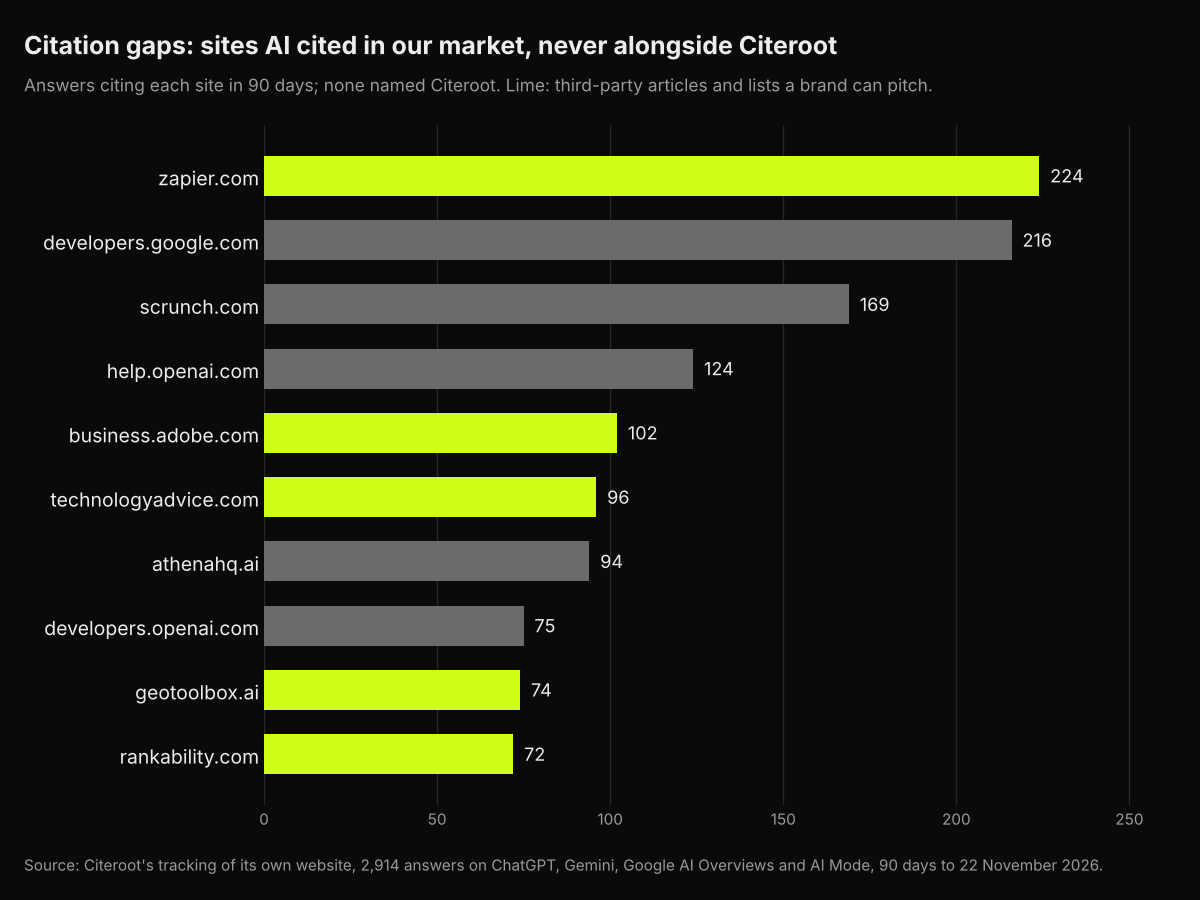
Five of the ten are third-party articles and lists: zapier.com was cited in 224 answers, 222 of which named a competitor, and technologyadvice.com in 96, 95 of them alongside a competitor. Those are the pages to pitch. Two are competitors' own sites and three are Google's and OpenAI's documentation, which you cannot join but can learn from: the assistants cite primary sources, so your own documentation should be the primary source on your product.
These are one market's figures. Your own gap list will look different, and producing it is the main reason to pay for a tracker rather than rely on the free reports.
#Common mistakes
- Buying before setting up the free reports. Search Console, Bing Webmaster Tools and Business Hub give first-party data at no cost.
- Counting mentions and calling it citation tracking. A mention count says nothing about which pages the assistant trusted.
- Tracking one platform. Google's AI features cite forums, video and social pages far more than ChatGPT does.
- Ignoring the gap list. A chart of your citation rate is less useful than the list of pages cited when competitors are named.
- Trusting a tiny sample. With a handful of questions, a week's change is usually noise.
#Where Citeroot fits
Citeroot stores every answer from ChatGPT, Gemini, Google AI Overviews and Google AI Mode with the links it cites, and its Source Map groups the cited sites by kind and lists the gaps where competitors are cited and you are not, as in the chart above. Its agent can then draft the page or pitch a gap calls for, and you approve each one. It does not cover Copilot, Perplexity or Claude on its self-serve plans, so pair it with Bing Webmaster Tools if Copilot matters to you.
#Frequently asked questions
#What is the difference between citation tracking and mention tracking?
Mention tracking counts how often your name appears in AI answers. Citation tracking records which pages the answers link to as sources, including yours. Citations show where the assistant got its information, so they tell you which pages to improve or pitch.
#Is there free AI citation tracking software?
Yes, for one platform at a time. Google Search Console covers AI Overviews and AI Mode, Bing Webmaster Tools covers Copilot, and OpenAI's Business Hub covers ChatGPT; Citeroot's free plan covers all four of ChatGPT, Gemini, AI Overviews and AI Mode for five questions a week.
#Which AI platforms should a citation tracker cover?
The ones your buyers use. Most businesses start with ChatGPT and Google's AI Overviews, and add Gemini, AI Mode, Copilot or Perplexity where their audience is.
#How many questions should I track?
Twenty to 50 buyer questions give a stable picture. In Otterly.AI's study of 252,407 answers, results measured with 10 prompts ranged from 39% to 71%, against 51% to 60% with 100 prompts.
#Next step
Set up the three free reports this week, then run 20 buyer questions by hand and list every site cited when a competitor is named. If you want that list kept up to date on four AI platforms, start Citeroot's free plan, or try any of the trackers above on its trial.
#Sources
- Google Search Central Blog, Introducing Search Generative AI performance reports in Search Console, 3 June 2026.
- Carolyn Shelby, Search Engine Journal, Google Now Reports AI Search Impressions. Here's How To Read Them, 4 August 2026.
- Microsoft Bing, Introducing AI Performance in Bing Webmaster Tools Public Preview, February 2026.
- OpenAI, Setting up your business on ChatGPT, read 22 November 2026.
- Otterly.AI, We measured how stable AI citations and brand mentions really are, September 2026.
- Vendor pricing pages linked under the comparison table, read 22 November 2026.
- Citeroot answer data: 2,914 answers about Citeroot's own market on four AI platforms (90 days to 22 November 2026).