On this page
- Key takeaways
- What does checking ChatGPT citations mean?
- How to verify that a ChatGPT citation is real
- 1. Make ChatGPT show its sources
- 2. Open every link
- 3. Find the claim on the page
- 4. Check papers by title and DOI
- 5. Use a reference checker for long lists
- Why ChatGPT's citations need checking
- How to check which sites ChatGPT cites in your market
- What AI recommends for this question: our data
- Common mistakes
- Where Citeroot fits
- Frequently asked questions
- Why does ChatGPT sometimes give no sources?
- Can ChatGPT make up citations?
- Is there a free way to see which sites ChatGPT cites for my business?
- Do trackers read the ChatGPT app or the API?
- Next step
- Sources
Tools to check ChatGPT citations do one of two jobs. To verify a citation, open the link, find the claimed line on the page, and check papers by their DOI in Google Scholar or Crossref. To see which websites ChatGPT cites in your market, use an AI visibility tracker, such as Otterly.AI, Peec AI or Citeroot.
By Nadir Ali, founder of Citeroot. Updated 22 November 2026. We build Citeroot, so weigh that: it appears in the table below, not at the top of it. Prices were read from each vendor's own pricing page on 22 November 2026.
#Key takeaways
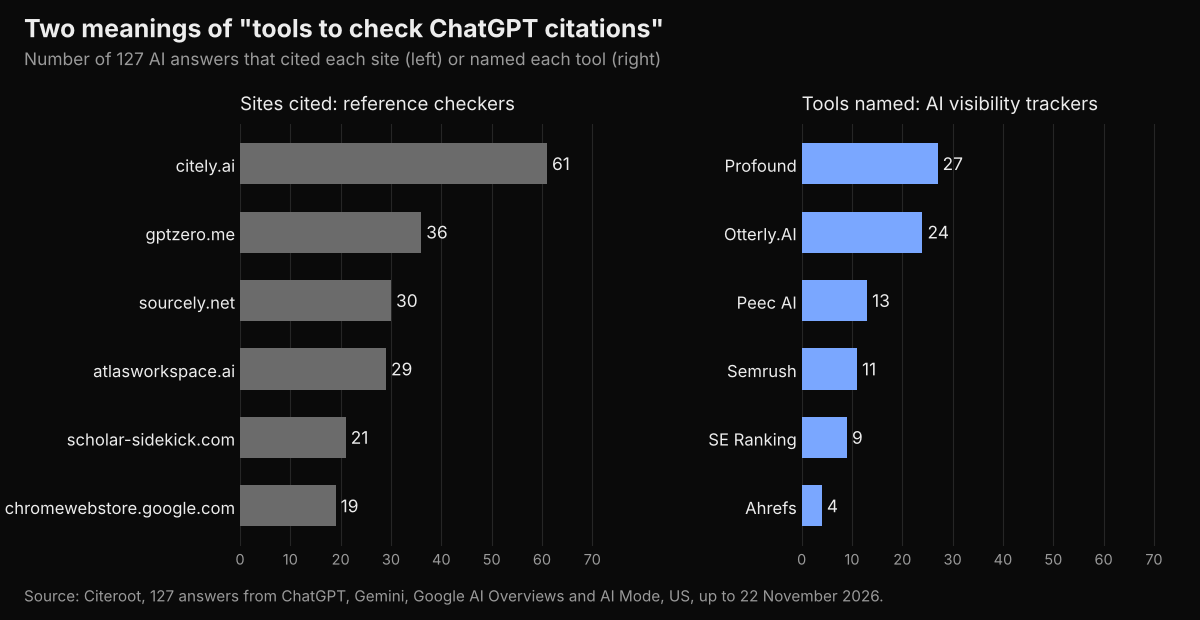
- The phrase has two meanings. In 127 AI answers to "tools to check chatgpt citations", assistants most often cited reference-checking sites such as citely.ai (61 answers) and gptzero.me (36), and named AI visibility trackers such as Profound (27) and Otterly.AI (24). Citeroot was named in none.
- Citations do need checking. In the Tow Center's March 2025 test of eight AI search tools, they gave incorrect answers to more than 60% of 1,600 queries about news articles, and ChatGPT search misidentified 134 of 200 articles.
- A two-minute manual check catches most problems: open the link, confirm the page is the one described, and search it for the claim.
- For marketing, the question is which sites ChatGPT cites for your buyers' questions. In 1,277 ChatGPT answers Citeroot collected over 90 days, 22% cited no source, and the rest listed about five sources each.
- OpenAI's Business Hub counts how often ChatGPT referenced your website; a tracker adds the answers, the sources and the competitors.
#What does checking ChatGPT citations mean?
Checking ChatGPT citations means one of two jobs, and each needs a different tool. Verification asks whether the sources ChatGPT gave are real and say what it claims; students, researchers, journalists and lawyers need this. Monitoring asks which websites ChatGPT cites when people ask about your market, and whether your site is among them; marketers and business owners need this.
The two get mixed up, as our data below shows. Decide which job you have before you pick a tool, because a reference checker will not tell you who ChatGPT recommends, and a visibility tracker will not tell you whether a quoted statistic is accurate.
#How to verify that a ChatGPT citation is real
Verifying a citation means checking that the source exists and supports the claim. Do it for any fact you will repeat, publish or act on.
#1. Make ChatGPT show its sources
OpenAI's help page on ChatGPT search says answers that use search include inline citations, with the sources listed alongside. An answer without links has not shown you where its facts came from, so treat it as unverified.
#2. Open every link
Check that the page loads and is the page described, with the same title, author and date. The Tow Center for Digital Journalism found that generative search tools fabricated links and cited copied or syndicated versions of articles instead of the originals.
#3. Find the claim on the page
Search the page for a distinctive word or number from ChatGPT's sentence. A real page that does not contain the claim is as much a problem as a broken link.
#4. Check papers by title and DOI
For academic references, search the exact title in Google Scholar and resolve the DOI at doi.org or look it up in Crossref. A reference whose title, journal or DOI does not match anything is a sign the citation was invented.
#5. Use a reference checker for long lists
For a long bibliography, a reference-checking tool saves time. AI answers to this question pointed most often to citely.ai, gptzero.me and sourcely.net; we have not tested them, so try a few references you already know are right or wrong before you rely on one.
#Why ChatGPT's citations need checking
AI search tools often get citations wrong while sounding sure of themselves. In AI Search Has a Citation Problem, published by the Columbia Journalism Review in March 2025, Tow Center researchers Klaudia Jaźwińska and Aisvarya Chandrasekar ran 1,600 queries on eight AI search tools, asking each to identify the article an excerpt came from. Collectively the tools answered more than 60% of queries incorrectly.
ChatGPT search misidentified 134 of its 200 articles, signalled uncertainty in only 15 answers and never declined to answer. The study is from early 2025 and the tools have changed since, but the habit it describes, confident answers with wrong sources, is the reason to open the links.
#How to check which sites ChatGPT cites in your market
Monitoring means asking ChatGPT your buyers' questions and recording the sources. You can do it three ways, and most businesses end up using all three.
- By hand. Run 20 buyer questions in fresh chats, copy every cited link, and tally the domains. Our guide to tracking brand mentions in ChatGPT sets out the weekly method.
- OpenAI's Business Hub. Since 10 November 2026, OpenAI's Business Hub shows a verified business how often ChatGPT referenced its website over the past 28 days, without the questions, answers or competitors.
- An AI visibility tracker. A tracker asks your questions on a schedule and stores each answer with its sources. These are the trackers AI answers named for this question, with their entry plans on 22 November 2026.
| Tool | Named in 127 AI answers | Entry plan on 22 November 2026 | Questions tracked on that plan |
|---|---|---|---|
| Profound | 27 | Enterprise only, price on request | Not listed |
| Otterly.AI | 24 | Lite: €29/mo | 16 |
| Peec AI | 13 | Starter: $95/mo | 50 |
| Semrush AI Visibility Toolkit | 11 | $99/mo per domain, billed annually | 25 |
| SE Ranking | 9 | Core: $129/mo | 25 |
| Ahrefs | 4 | Lite: $129/mo | 5 |
| Citeroot | 0 | Free plan; Grow $59/mo, or $49/mo billed yearly | 5 weekly on Free; 30 daily on Grow |
Sources: Profound, Otterly.AI, Peec AI, Semrush, SE Ranking, Ahrefs and Citeroot. For cost per answer, see our AI visibility tool pricing guide. Whichever you try, check that it shows the cited links for each answer and keeps the full answer text, not just a mention count.
#What AI recommends for this question: our data
AI assistants mostly read "tools to check chatgpt citations" as a request to verify sources. Citeroot has collected 127 answers to the question from ChatGPT, Gemini, Google AI Overviews and AI Mode in the US. The sites cited most were reference checkers, while a smaller share of answers named AI visibility trackers.
ChatGPT's own citing habits explain why monitoring takes more than one check. Of 1,277 ChatGPT answers Citeroot collected in the 90 days to 22 November 2026, across 160 questions in 10 markets, 277 (22%) cited no source at all. The other 1,000 carried 4,953 citations, about five per answer, and 90.5% of those went to editorial pages such as articles, reviews and guides.
#Common mistakes
- Trusting a citation without opening it. A link can be broken, invented or point to a copy of the original.
- Assuming the cited page supports the exact claim. Search the page for the figure or phrase.
- Using the wrong kind of tool. Reference checkers verify sources; visibility trackers monitor which sources ChatGPT uses about your market.
- Judging from one answer. ChatGPT's sources change from run to run, so look at many answers.
- Ignoring answers with no sources. More than one ChatGPT answer in five cited nothing in our data.
#Where Citeroot fits
Citeroot is for the second job. It asks your buyer questions on ChatGPT, Gemini, Google AI Overviews and Google AI Mode on a schedule, stores every answer with the links it cites, and its Source Map shows which domains are cited across your questions and where competitors are cited and you are not. It does not check whether a cited page supports a claim; a person reads the answers for that.
#Frequently asked questions
#Why does ChatGPT sometimes give no sources?
ChatGPT decides for itself when to search the web, and only answers that use search show inline citations. In our data, 22% of ChatGPT answers cited no source.
#Can ChatGPT make up citations?
Yes. The Tow Center's 2025 study found generative search tools fabricated links and cited copied versions of articles. Open every link before you rely on it.
#Is there a free way to see which sites ChatGPT cites for my business?
Yes. Check by hand with a fixed set of questions, claim your business in OpenAI's Business Hub for its 28-day count, and look for utm_source=chatgpt.com visits in Google Analytics. Citeroot's free plan also checks five questions every week.
#Do trackers read the ChatGPT app or the API?
It varies, so ask before you buy, because the two can give different answers. Citeroot collects ChatGPT answers from the ChatGPT website; our article on API and app answers explains why that matters.
#Next step
If you need to verify sources, open each link and search it for the claim before you use it. If you need to know which sites ChatGPT cites about your market, run ten buyer questions this week and tally the domains, or start Citeroot's free plan to have five questions checked every week on four AI platforms.
#Sources
- OpenAI, ChatGPT search, read 22 November 2026.
- Klaudia Jaźwińska and Aisvarya Chandrasekar, Columbia Journalism Review, AI Search Has a Citation Problem, March 2025.
- OpenAI, Setting up your business on ChatGPT, read 22 November 2026.
- Vendor pricing pages linked under the table, read 22 November 2026.
- Citeroot answer data: 127 answers to one tracked question (US, up to 22 November 2026) and 1,277 ChatGPT answers across 160 questions in 10 markets (90 days to 22 November 2026).