On this page
- Key takeaways
- What is LLM brand awareness?
- Which metrics measure LLM brand awareness?
- Mention rate or share of voice? Our data
- How to measure LLM brand awareness, step by step
- 1. Write two sets of questions
- 2. Collect answers on each platform
- 3. Code each answer
- 4. Calculate the six metrics with ranges
- 5. Compare like with like
- Common mistakes
- Where Citeroot fits
- Frequently asked questions
- What is a good share of voice in AI answers?
- How is LLM brand awareness different from SEO rankings?
- How often should I measure LLM brand awareness?
- Can I measure LLM brand awareness for free?
- Next step
- Sources
To measure LLM brand awareness, ask ChatGPT, Gemini and Google's AI a fixed set of buyer questions and track six numbers: unaided mention rate, aided accuracy, share of voice, citation rate, recommendation rate and position. Report each per platform with its sample size, and separate questions that name you from those that do not.
By Nadir Ali, founder of Citeroot. Updated 22 November 2026. The examples use data Citeroot collected about its own market, and each figure says how many answers, which platforms and which dates.
#Key takeaways
- LLM brand awareness is how readily AI assistants name and correctly describe your brand when people ask about your category. It works like classic brand awareness: unaided (named without being asked about) and aided (described correctly when asked by name).
- Mention rate and share of voice answer different questions. In 615 ChatGPT answers in Citeroot's market, Semrush was named in 57% of answers but held 18% of all brand mentions; Citeroot was named in 8% and held 3%.
- Unaided awareness is where new brands lose. ChatGPT, Gemini and both Google AI features named Citeroot in none of the answers to problem, shortlist and constraint questions over 28 days.
- Every rate needs its sample size and range. Citeroot's ChatGPT mention rate moved from 10% to 8% between two 28-day windows, but the ranges overlapped, so the change counts as normal variation.
- Small samples mislead: in Otterly.AI's study of 252,407 answers, results measured with 10 prompts ranged from 39% to 71%.
#What is LLM brand awareness?
LLM brand awareness is the extent to which large language models, the AI systems behind ChatGPT, Gemini and Google's AI answers, bring up your brand and describe it accurately. Because buyers now ask these assistants for recommendations, the brands an assistant names first are the brands a buyer hears about first.
The classic split between unaided and aided awareness fits well. Unaided awareness is whether the assistant names you when a buyer asks about the category without naming any brand, such as "best invoicing software for freelancers". Aided awareness is whether the assistant describes you correctly when the buyer asks about you by name, such as "is this tool any good?". You need both numbers, because they have different causes and different fixes.
#Which metrics measure LLM brand awareness?
Six metrics cover awareness from first mention to recommendation. Calculate each one per platform, because ChatGPT, Gemini and Google's AI features behave differently.
| Metric | How to calculate it | What it tells you |
|---|---|---|
| Unaided mention rate | Answers to unbranded questions that name you, divided by all answers to those questions | Whether AI brings you up for buyers who do not know you yet |
| Aided accuracy | Answers to branded questions that describe your product, price and audience correctly, divided by all answers to those questions | Whether AI tells the truth about you once you are asked about |
| Share of voice | Your mentions divided by all brand mentions in the same answers | How much of the conversation you hold against competitors |
| Citation rate | Answers that link to your website, divided by all answers | Whether AI trusts your pages as a source |
| Recommendation rate | Answers that present you as a good choice, divided by all answers | Whether being named turns into being chosen |
| Position when named | Your average place in the list of brands an answer names | Whether you are the first option or an afterthought |
Two outcome signals sit alongside these: visits from AI assistants in your analytics, such as sessions tagged utm_source=chatgpt.com, and your pages' impressions in Google Search Console's generative AI report. They show effects, but they cannot show awareness without a click, so keep them beside the six metrics, not in place of them.
#Mention rate or share of voice? Our data
Mention rate and share of voice are both called "visibility", but they measure different things. Mention rate asks how many answers name you; share of voice asks what slice of all brand mentions is yours. Citeroot tracks its own market on ChatGPT, and in the 28 days to 22 November 2026 it collected 615 ChatGPT answers in the US.
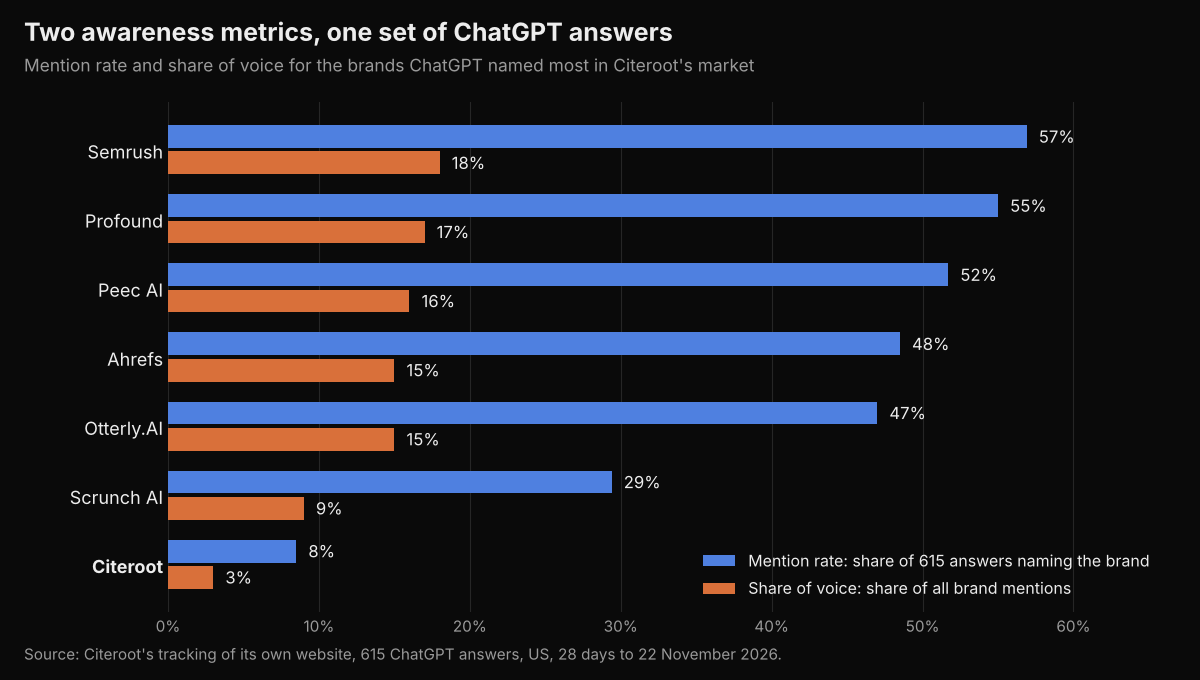
Semrush was named in 350 of the 615 answers, a mention rate of 57%, but because most answers named several tools, its share of all brand mentions was 18%. Citeroot was named in 52 answers (8%) and held 3%. A high mention rate with a modest share of voice is normal in a crowded category; what matters is the trend in both and the gap to the leader.
The pattern held on every platform. Over the same 28 days, Citeroot's share of voice was 3% on ChatGPT, Gemini, Google AI Mode and Google AI Overviews, while Semrush held between 18% and 22%. Whenever Citeroot was named, it was named first on average, so its awareness problem is how often it comes up, not where.
#How to measure LLM brand awareness, step by step
The method below works by hand for 20 questions or with a tracker for more. Keep it identical from month to month, so the numbers are comparable.
#1. Write two sets of questions
Write 20 to 50 unbranded buyer questions for unaided awareness, and five to ten branded questions for aided awareness, such as whether your product is good for a given job or how it compares with a named rival. Keep the two sets apart in every report; mixing them makes awareness look far higher than it is.
#2. Collect answers on each platform
Ask every question on ChatGPT, Gemini, Google AI Overviews and Google AI Mode, in fresh sessions. Collect at least 30 answers per platform before you trust a rate, because answers change from run to run.
#3. Code each answer
For each answer, record whether you were named, your position, whether your site was linked, whether you were recommended, and every competitor named. For branded answers, also note anything wrong or out of date: in answers collected on 21 November 2026, ChatGPT still described an old 14-day free trial from Citeroot's pricing page, which now offers a 3-day trial.
#4. Calculate the six metrics with ranges
Work out each metric per platform and give it a 95% range, not just a single number. In Citeroot's ChatGPT data, the 8% mention rate came from 52 of 615 answers, with a range of 7% to 11%.
#5. Compare like with like
Compare each 28-day window with the one before, and call a change only when the ranges do not overlap. Citeroot's ChatGPT mention rate was 10% in the previous window and 8% in this one; the ranges overlapped, so the honest reading is no change.
#Common mistakes
- Mixing branded and unbranded questions. Branded questions are answered from your own site and inflate every awareness metric.
- Reporting one blended number. A single "AI visibility" score hides the platform and stage where you are missing.
- Treating share of voice as mention rate. A 15% share of voice can mean you are named in half of all answers.
- Calling every wobble a trend. Without ranges, a two-point move on a small sample looks like news.
- Measuring mentions but not accuracy. Being named with the wrong price or audience can cost you the buyer.
#Where Citeroot fits
Citeroot measures these metrics for you on ChatGPT, Gemini, Google AI Overviews and Google AI Mode. It records named, cited and recommended separately, shows share of voice against your competitors and your position when named, splits results by buyer stage so unaided and aided awareness stay apart, and gives each rate with its 95% range, labelling a change as normal variation when the ranges overlap. See the Answer Tracker.
#Frequently asked questions
#What is a good share of voice in AI answers?
It depends on how crowded your category is. In Citeroot's market, the leader held 18% to 22% of brand mentions across four platforms, so a share in the teens already marks a leading brand there. Compare yourself with the leader in your own category rather than with a fixed target.
#How is LLM brand awareness different from SEO rankings?
SEO rankings measure where your page appears in a list of links. LLM brand awareness measures whether an assistant names, describes and recommends your brand in its answer, often with no list of links at all. Strong rankings help, because AI features cite pages, but they do not guarantee a mention.
#How often should I measure LLM brand awareness?
Monthly is enough for most brands, using 28-day windows. Weekly or daily collection helps when you are changing pages and want to see the effect sooner, but report the trend over several windows.
#Can I measure LLM brand awareness for free?
Yes, by hand. Twenty unbranded and five branded questions asked monthly on each platform give you a baseline, and Citeroot's free plan tracks five questions every week on four platforms.
#Next step
Write your two question sets this week and record the six metrics for ChatGPT first, with sample sizes. Then read our guide to tracking brand mentions in ChatGPT for the weekly routine, or start Citeroot's free plan to have the answers collected for you.
#Sources
- Otterly.AI, We measured how stable AI citations and brand mentions really are, September 2026.
- OpenAI, Publishers and developers FAQ, read 22 November 2026.
- Google Search Central Blog, Introducing Search Generative AI performance reports in Search Console, 3 June 2026.
- Citeroot answer data: 615 ChatGPT answers and 2,257 answers on four platforms about Citeroot's own market (US, 28 days to 22 November 2026).