On this page
- Key takeaways
- What counts as ChatGPT recommending your business?
- What does ChatGPT's Business Hub show?
- How to check by hand in 15 minutes
- 1. Write ten questions your buyers ask
- 2. Open a fresh chat
- 3. Ask each question and let ChatGPT search
- 4. Record four things
- 5. Repeat on three different days
- Recommended or just named? Our data
- How to see the visits ChatGPT sends you
- Can ChatGPT read your website?
- Common mistakes
- Where Citeroot fits
- Frequently asked questions
- Does ChatGPT recommend the same businesses to everyone?
- Is Business Hub enough to know if ChatGPT recommends me?
- Can local businesses use Business Hub?
- Does blocking GPTBot stop ChatGPT from recommending my business?
- How often should I check?
- Next step
- Sources
To know if ChatGPT recommends your business, claim it in OpenAI's Business Hub for its 28-day count of mentions and clicks, then ask ChatGPT ten of your customers' questions in fresh chats and note whether you are named, linked or recommended. Business Hub counts your website; only your own checks show the recommendations and who is named instead.
By Nadir Ali, founder of Citeroot. Updated 22 November 2026. OpenAI's help pages are cited where they apply; the data comes from answers Citeroot collected, and each figure says how many answers, which platforms and which dates.
#Key takeaways
- Since 10 November 2026, OpenAI's Business Hub (in beta) shows verified businesses their mentions, website clicks and discovery topics in ChatGPT over the past 28 days.
- For an online business, a Business Hub mention counts only when ChatGPT points to your website, not when it names your brand without one. The Hub shows no prompts and no competitors, and it does not say whether you were recommended.
- A recommendation is stricter than a mention. In Citeroot's tracking of its own brand (2,187 answers, 28 days), Google AI Overviews and AI Mode named Citeroot in 7% to 8% of answers but recommended it in 2%, while ChatGPT named it in 9% and recommended it in 8%.
- One check is not enough: in Otterly.AI's study of 252,407 answers, results measured with 10 prompts ranged from 39% to 71%.
- OpenAI says ChatGPT adds
utm_source=chatgpt.comto referral links, so the visits it sends can be counted in Google Analytics.
#What counts as ChatGPT recommending your business?
ChatGPT recommends your business when it puts you forward as a good choice, not only when it lists your name. Three results are worth telling apart, because each one means something different.
- Mention: your business name appears in the answer.
- Citation: the answer links to a page on your website as a source.
- Recommendation: the answer presents you as an option to choose, such as "a good fit for small teams" or "worth booking if you need weekend hours".
A business can be cited without being recommended, and recommended without being linked. Log all three separately, and read the sentence around your name: "Brand A is popular, but Brand B is better value" names you without recommending you.
#What does ChatGPT's Business Hub show?
ChatGPT's Business Hub is OpenAI's free dashboard for verified businesses, launched in beta on 10 November 2026. OpenAI's help article on setting up your business says that once your claim and identity check are approved, its Insights page adds up your mentions, website clicks and discovery topics over the past 28 days.
The definitions matter. For an online business, OpenAI counts a mention only when ChatGPT points to the business's website, so your name appearing on its own does not count; for a local business, a mention counts when ChatGPT shows a result for that location. OpenAI also says businesses do not receive individual prompts or conversations, and that a blank metric can mean activity has not reached the reporting threshold.
Claiming is free and needs no ads account. You verify by business phone, business email, a DNS record on your domain or a Shopify connection, then complete an identity check with Persona. OpenAI notes that local stores and restaurants can currently claim only an existing US listing, and that claiming "doesn't guarantee increased visibility", nor control over ChatGPT's own recommendations. Our Business Hub guide walks through the claim.
| What you want to know | Business Hub | Your own checks |
|---|---|---|
| How often ChatGPT references your website | Yes, 28 days | Partly, from the answers you sample |
| Clicks from ChatGPT to your site | Yes | No (use Google Analytics) |
| Whether you were recommended or only named | No | Yes |
| Which competitors were named instead | No | Yes |
| The exact questions and answers | No | Yes |
#How to check by hand in 15 minutes
A manual check shows what Business Hub cannot: the answers themselves, the recommendations and the competitors. It takes about 15 minutes for ten questions.
#1. Write ten questions your buyers ask
Mix discovery questions ("best accountant for freelancers in Austin"), problem questions ("how do I file a late tax return") and comparison questions ("Xero or QuickBooks for a small bakery"). Leave out questions that name your business, because those are answered from your own site.
#2. Open a fresh chat
Use a temporary chat, or turn memory off, so your own history does not shape the answer. You want the answer a new customer would see, not one coloured by your past conversations.
#3. Ask each question and let ChatGPT search
OpenAI's ChatGPT search help page says ChatGPT "will automatically search the web" when a question could benefit from it, and that answers using search contain inline citations. For a local question, ask as a customer in your area would, with the city in the question.
#4. Record four things
Note whether you were named, whether your site was linked, whether you were recommended, and which businesses were named instead. Copy the source links at the end of each answer.
#5. Repeat on three different days
One answer is a single draw. A pattern across three runs of ten questions, 30 answers in all, is evidence you can act on; one screenshot is not.
#Recommended or just named? Our data
Being named and being recommended are different results, and the gap between them changes by platform. Citeroot tracks its own brand on ChatGPT, Gemini, Google AI Overviews and Google AI Mode; in the 28 days to 21 November 2026 it collected 2,187 answers in the US.
| Platform | Answers | Named Citeroot | Recommended Citeroot |
|---|---|---|---|
| ChatGPT | 600 | 9% | 8% |
| Gemini | 600 | 9% | 6% |
| Google AI Mode | 570 | 8% | 2% |
| Google AI Overviews | 417 | 7% | 2% |
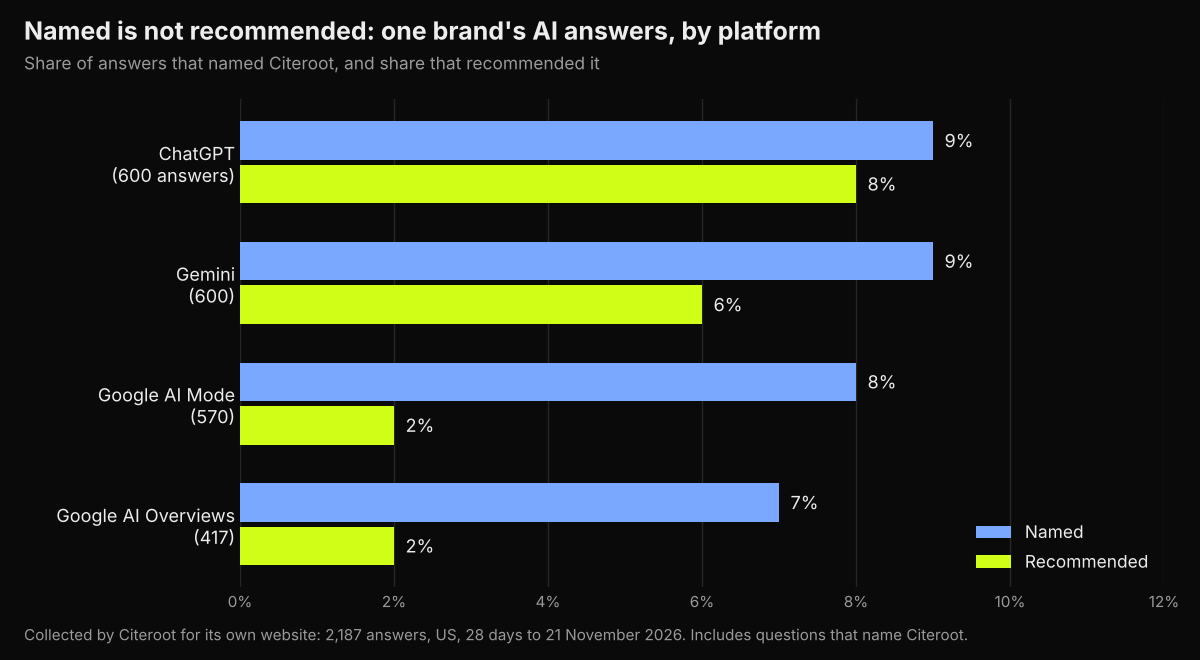
In this one brand's data, ChatGPT recommended almost every time it named the brand, while Google's AI Overviews and AI Mode named it three to four times as often as they recommended it. These figures describe one brand in one market and include questions that name Citeroot, so they are an example of the gap, not a rule. Measure your own: count recommendations separately from mentions.
The answers to this question show where buyers are being sent for help. Citeroot has collected 135 answers to "how do I know if chatgpt recommends my business"; the most cited sites were reddit.com (42 answers), youtube.com (41) and help.openai.com (25).
#How to see the visits ChatGPT sends you
ChatGPT tags its outgoing links, so its visits can be counted. OpenAI's publishers and developers FAQ says ChatGPT "automatically includes the UTM parameter utm_source=chatgpt.com in referral URLs", which lets Google Analytics count that traffic.
Put Business Hub's click count next to your chatgpt.com sessions in Google Analytics for the same 28 days. The two will not match exactly, because some clicks never become recorded visits, but a large gap is worth investigating. Neither number counts people who read your name and visited later, so treat both as the least ChatGPT is doing for you.
#Can ChatGPT read your website?
ChatGPT can cite only pages its search crawler is allowed to read. OpenAI's crawler overview says sites that block OAI-SearchBot "will not be shown in ChatGPT search answers", though they can still appear as navigational links. GPTBot, the training crawler, is controlled separately.
Check your robots.txt for a rule that blocks OAI-SearchBot, and check that your firewall or CDN is not blocking it either. Our free AI crawler checker shows which AI crawlers your robots.txt admits.
#Common mistakes
- Trusting one screenshot. A single answer can name you by luck; check at least 30 answers before deciding.
- Counting mentions as recommendations. Read the sentence around your name before you log it.
- Reading Business Hub mentions as brand mentions. For an online business, the Hub counts references to your website, not your name.
- Asking questions that name you. Those are answered from your own site and flatter the result.
- Blocking OAI-SearchBot by accident. A blanket block on AI bots in robots.txt can keep you out of ChatGPT search answers.
#Where Citeroot fits
Citeroot asks your buyers' questions on ChatGPT, Gemini, Google AI Overviews and Google AI Mode on a schedule and stores every answer. For each answer it records whether you were mentioned, cited and recommended, shows who was named instead, and gives each rate with its range, so a small change is labelled as normal variation. It fills the gaps Business Hub leaves: the answers, the recommendations and the competitors. See the Answer Tracker.
#Frequently asked questions
#Does ChatGPT recommend the same businesses to everyone?
No. The same question can return different businesses from one run to the next, and the wording of the question changes the answer too. That is why a rate across many answers is more useful than one screenshot.
#Is Business Hub enough to know if ChatGPT recommends me?
No. Business Hub shows how often ChatGPT referenced your website and how many clicks followed, but not whether you were recommended or who was named instead. Pair it with your own checks or a tracking tool.
#Can local businesses use Business Hub?
Yes, with limits. OpenAI says local stores and restaurants can currently claim only an existing US listing, and availability depends on the business's location and type.
#Does blocking GPTBot stop ChatGPT from recommending my business?
No. GPTBot collects content for training; OAI-SearchBot decides whether your pages can appear in ChatGPT search answers, and OpenAI controls the two separately.
#How often should I check?
Check monthly by hand with the same ten questions, and look at Business Hub's 28-day insights at the same time. For weekly or daily checks across several AI engines, use a tracking tool.
#Next step
Claim your business in ChatGPT's Business Hub, then run ten of your customers' questions this week and log mentions, recommendations and competitors. For ongoing tracking, our guide on how to track brand mentions in ChatGPT sets out a weekly method, and Citeroot's free plan checks five questions every week on four AI engines.
#Sources
- OpenAI, Setting up your business on ChatGPT, read 22 November 2026.
- OpenAI, Publishers and developers FAQ, read 22 November 2026.
- OpenAI, ChatGPT search and Overview of OpenAI crawlers, read 22 November 2026.
- Otterly.AI, We measured how stable AI citations and brand mentions really are, September 2026.
- Citeroot answer data: 2,187 answers about Citeroot's own market (28 days to 21 November 2026) and 135 answers to one tracked question, ChatGPT, Gemini, Google AI Overviews and Google AI Mode, US.