On this page
- Key takeaways
- What is llms.txt?
- Does llms.txt help AI visibility? What the data shows
- Did llms.txt help us? Our own experience
- What helps AI visibility instead?
- Should you add an llms.txt file anyway?
- Common mistakes
- Where Citeroot fits
- Frequently asked questions
- Is llms.txt the same as robots.txt?
- Does Google use llms.txt?
- Does ChatGPT use llms.txt?
- Can an llms.txt file hurt my site?
- Next step
- Sources
No measurable effect so far. Two large studies found no link between having an llms.txt file and AI citations or visibility, Ahrefs found 97% of llms.txt files got no requests at all in May 2026, and Google says to ignore llms.txt for its AI search features. Crawl access and clear pages matter far more.
By Nadir Ali, founder of Citeroot. Updated 22 November 2026. We publish an llms.txt file and offer a free llms.txt generator, so weigh that: the evidence below is from independent studies and Google's own guidance.
#Key takeaways
- llms.txt is a proposed Markdown file at the root of a website that lists its most important pages for AI tools. It is not a control file, and no major AI search engine has said it relies on it.
- SE Ranking's analysis of about 300,000 domains found 10.13% had an llms.txt file and no link between the file and how often a domain was cited by AI; removing it from their model made predictions more accurate.
- Ahrefs data on 137,000 domains, reported by Search Engine Journal, found 97% of llms.txt files received zero requests in May 2026, and AI retrieval bots made 1.1% of the requests that did happen.
- Google's guide to generative AI search tells site owners to ignore llms.txt for AI Overviews and AI Mode.
- We publish an llms.txt ourselves, and AI still named Citeroot in none of the unbranded answers we tracked over 28 days. The file did not make us visible.
#What is llms.txt?
llms.txt is a proposed plain-text file, written in Markdown and placed at the root of a website, that summarises the site and links to its most useful pages for large language models to read. The idea is to give AI tools a clean map of a site without the menus, scripts and adverts of normal pages.
It is often called "robots.txt for AI", but the comparison misleads. robots.txt tells crawlers what they may and may not fetch, and AI companies document how their crawlers obey it. llms.txt controls nothing; it is a suggestion that only matters if an AI system chooses to read it.
#Does llms.txt help AI visibility? What the data shows
The studies so far agree: llms.txt is used by a minority of sites and shows no measurable effect on AI citations or visibility.
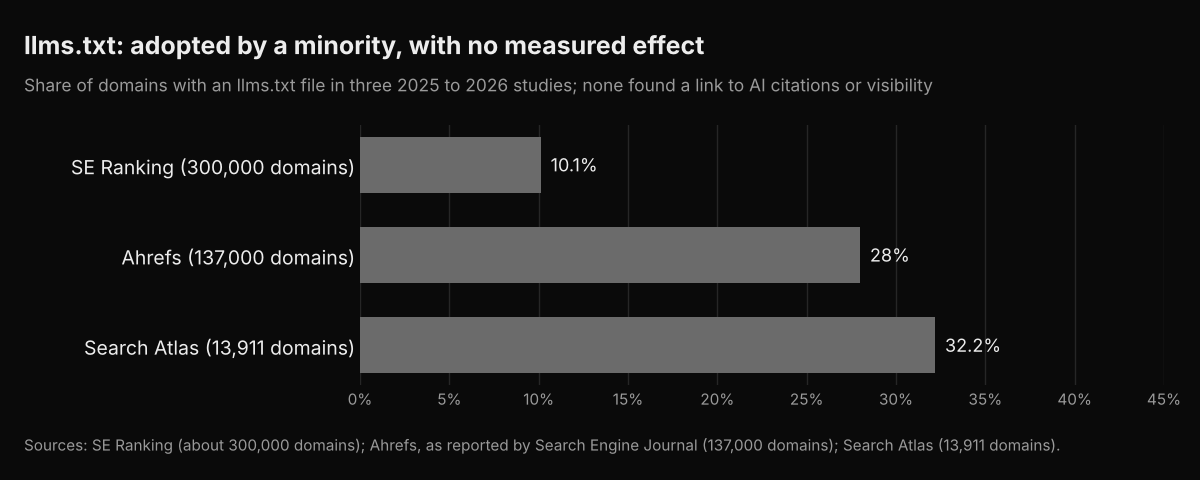
- SE Ranking analysed about 300,000 domains and found 10.13% had an llms.txt file. Both its statistical tests and its machine-learning model found no effect of the file on how often a domain was cited by AI, and dropping the variable improved the model's accuracy.
- Ahrefs looked at 137,000 domains, of which about 28% published an llms.txt file. According to Search Engine Journal's report, 97% of the files received zero requests in May 2026; AI retrieval bots accounted for 1.1% of the requests that did occur, and 12% came from tools auditing or scanning the files.
- Search Atlas compared 13,911 domains, 32.2% of them with an llms.txt file, against 83,387 visibility records across six AI platforms, and found that publishing the file did not produce a measurable gain.
Adoption varies with the sample: Ahrefs notes that its customers are more technical than the wider web, so its 28% likely overstates general adoption. The conclusion about effect does not vary.
Google is the clearest of the platforms. Its guide to generative AI search, last updated on 10 July 2026, lists llms.txt files among the things site owners can ignore for its generative AI features.
#Did llms.txt help us? Our own experience
Our own site is one more data point. Citeroot's last site health scan, on 14 October 2026, found an llms.txt file in place and no AI crawlers blocked. Yet across 2,257 answers on ChatGPT, Gemini, Google AI Overviews and Google AI Mode in the 28 days to 22 November 2026, AI named Citeroot in none of the answers to problem, shortlist and constraint questions, the ones asked before a buyer knows any brand.
That proves nothing about cause, since one site cannot. It does show that having the file is no shortcut: our visibility gap is about coverage on other sites and pages for unbranded questions, not a missing file. We offer a free llms.txt generator because people ask for one, and we tell them the same thing.
#What helps AI visibility instead?
The things with evidence behind them are access, clear pages and coverage on other sites. Spend your time there first.
- Let AI crawlers in. OpenAI's crawler overview says sites that block OAI-SearchBot "will not be shown in ChatGPT search answers". Our free AI crawler checker shows what your robots.txt allows.
- Put key content in the HTML. Pages whose text appears only after JavaScript runs may look empty to some AI crawlers; our guide to why brands go missing from ChatGPT explains the test.
- Write answer-first pages with evidence. In the GEO study (KDD 2024), citing sources, adding quotations and adding statistics raised visibility in AI answers by 30% to 40%.
- Earn mentions on the sites AI cites. Our guide to getting cited by AI assistants shows which kinds of sites each platform cites.
#Should you add an llms.txt file anyway?
Adding an llms.txt file is quick and does no known harm, so add one if you like, especially if you have documentation people read with AI tools. Just do not expect it to change what ChatGPT, Gemini or Google's AI say about you, and do not let it take time from the work above.
#Common mistakes
- Treating llms.txt as a control. It cannot block or allow anything; robots.txt does that.
- Expecting a visibility lift. The studies found none, and Google says to ignore the file.
- Blocking crawlers while adding llms.txt. A file that invites AI tools in does nothing if robots.txt keeps them out.
- Letting it go stale. If you publish one, keep its links current like any other page.
- Measuring success by the file's existence. Measure what AI answers say about you instead.
#Where Citeroot fits
Citeroot's site audit checks whether you publish an llms.txt and which of 20 AI crawlers your robots.txt admits, and our free generator writes the file if you want one. The part that shows whether anything worked is the tracking: Citeroot asks your buyer questions on ChatGPT, Gemini, Google AI Overviews and Google AI Mode and records whether you were named, cited and recommended. See the Answer Tracker.
#Frequently asked questions
#Is llms.txt the same as robots.txt?
No. robots.txt tells crawlers what they may fetch, and AI companies document how their crawlers follow it. llms.txt is a suggested summary of your site that AI tools may or may not read.
#Does Google use llms.txt?
Google's guide to generative AI search tells site owners to ignore llms.txt for its AI features, and says normal SEO practice applies instead.
#Does ChatGPT use llms.txt?
OpenAI's guidance for publishers centres on letting its crawlers, such as OAI-SearchBot, reach your pages. Ahrefs' data found AI retrieval bots made 1.1% of the requests to llms.txt files, so do not count on it being read.
#Can an llms.txt file hurt my site?
There is no evidence that it does. The risk is wasted effort, or relying on it while more important problems, such as blocked crawlers, go unfixed.
#Next step
Check your robots.txt with our free AI crawler checker before you touch llms.txt, then make sure your key pages answer buyer questions in their first paragraph. To see whether any change moves the answers, track ten buyer questions on Citeroot's free plan.
#Sources
- Yulia Deda, SE Ranking, Does LLMs.txt impact your AI visibility and citations? No, according to research, read 22 November 2026.
- Search Engine Journal, 97% Of LLMS.txt Files Got No Requests, Ahrefs Data Shows, 2026.
- Search Atlas, study of llms.txt adoption and LLM visibility, read 22 November 2026.
- Google Search Central, Optimizing for generative AI search, last updated 10 July 2026.
- OpenAI, Overview of OpenAI crawlers, read 22 November 2026.
- Citeroot data: site health scan of citeroot.app (14 October 2026) and 2,257 answers on four AI platforms (US, 28 days to 22 November 2026).