On this page
- Key takeaways
- What counts as being cited by an AI assistant?
- Which sites does each AI assistant cite? Our data
- How to get cited by AI assistants, step by step
- 1. Let each assistant reach your pages
- 2. Write one page per question, answer first
- 3. Publish the facts only you have
- 4. Get into the editorial articles and roundups
- 5. Show up where Google's AI looks: video, forums and social
- 6. Keep your business facts consistent
- 7. Track citations on each platform
- Common mistakes
- Where Citeroot fits
- Frequently asked questions
- Does schema markup help AI assistants cite you?
- Do AI assistants cite small companies?
- How long does it take to get cited?
- Which assistant should I focus on first?
- Is a citation better than a mention?
- Next step
- Sources
To get your company cited by AI assistants, make your pages crawlable and indexable, publish pages that answer specific questions with original figures, and earn coverage on the kinds of sites each assistant cites: editorial articles for ChatGPT and Gemini, and video, forum and social pages too for Google's AI Overviews and AI Mode. Then track citations per platform.
By Nadir Ali, founder of Citeroot. Updated 22 November 2026. Google's, OpenAI's and Microsoft's documentation is cited where it applies; the data comes from answers Citeroot collected, and each figure says how many answers, which platforms and which dates.
#Key takeaways
- A citation is a link to your page shown as a source in an AI answer. ChatGPT, Gemini, Google AI Overviews and Google AI Mode all show sources, but they cite different kinds of sites.
- In 4,527 answers Citeroot collected over 90 days, editorial pages took 90.5% of ChatGPT's citations and 92.4% of Gemini's, while forums, video and social sites took 22.9% of Google AI Overview citations and 19.9% of AI Mode's.
- An assistant can only cite what it can reach. ChatGPT search depends on OpenAI's OAI-SearchBot, and Google's AI features can only link to pages that are indexed and eligible to show a snippet.
- In the GEO study (KDD 2024), citing sources, adding quotations and adding statistics raised a page's visibility in AI answers by 30% to 40%. Original figures give assistants something to cite you for.
- When asked this very question, AI answers cited reddit.com in 47 of 132 answers and Google's developer documentation in 24, and named Semrush in 9 and Profound in 6.
#What counts as being cited by an AI assistant?
Being cited means an AI answer links to your page as one of its sources. A mention is your name appearing in the answer text, and a recommendation is the answer presenting you as a good choice; a citation is the link underneath, the part a reader can click.
Citations matter for two reasons. They can send visits you can measure, and they show which pages an assistant trusts for a question, which tells you what to improve. A company can be cited without being named, for example when an assistant uses its guide to explain a topic, so track citations and mentions separately.
#Which sites does each AI assistant cite? Our data
Each AI assistant leans on editorial pages, but Google's AI features cite video, forum and social pages far more than ChatGPT or Gemini do. Citeroot collected 4,527 answers from four platforms in the 90 days to 22 November 2026, for 160 questions across 10 markets, and classified every cited site by kind.
| Platform | Answers with sources | Citations | Editorial pages | Forums, video and social | Documentation |
|---|---|---|---|---|---|
| ChatGPT | 1,000 of 1,277 | 4,953 | 90.5% | 0.3% | 7.5% |
| Gemini | 1,013 of 1,212 | 3,566 | 92.4% | 5.8% | 1.5% |
| Google AI Mode | 1,094 of 1,151 | 2,940 | 75.9% | 19.9% | 3.2% |
| Google AI Overviews | 856 of 887 | 5,454 | 75.5% | 22.9% | 0.8% |
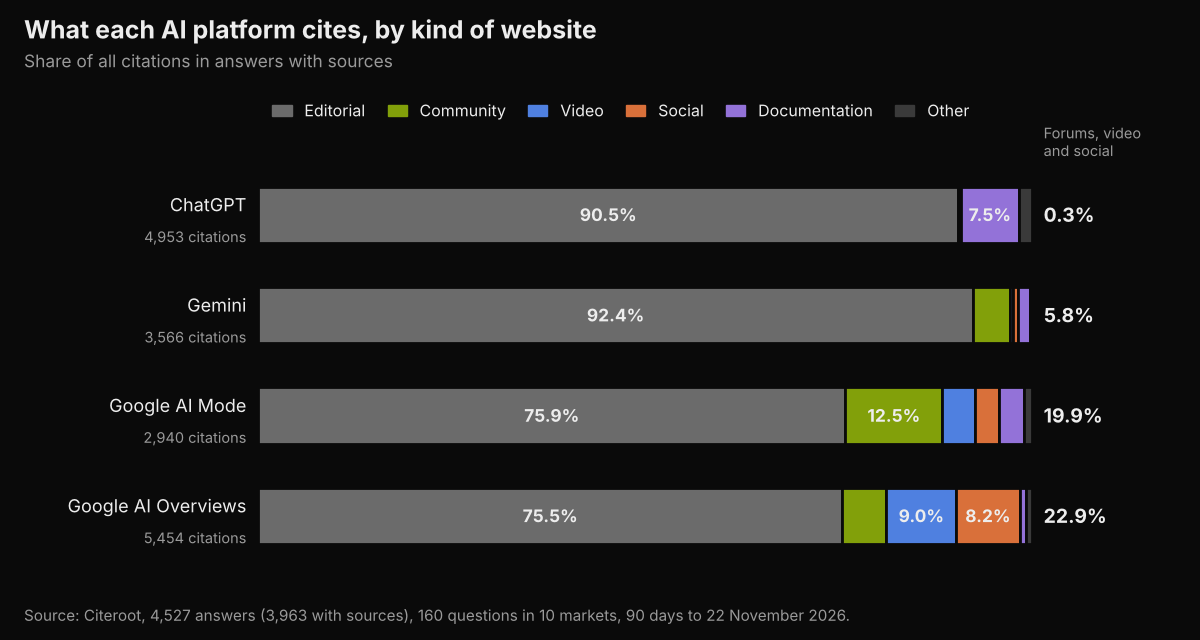
The differences are large enough to change your plan. In Google AI Overviews, youtube.com was cited in 53.7% of answers with sources, reddit.com in 29.1% and facebook.com in 25.8%, each counted across seven or more of the 10 markets. In Google AI Mode, reddit.com was cited in 32.7%. ChatGPT gave forums, video and social sites 0.3% of its citations and cited documentation pages more than any other platform did.
The answers to this question follow the same split. Citeroot has collected 132 answers to "how to get my company cited by ai assistants" from the four platforms in the US; the sites cited most were reddit.com (47 answers), youtube.com (28) and developers.google.com (24), with OpenAI's help and developer pages in 16 and 14. When the question is about how an AI product works, assistants go to the maker's own documentation.
#How to get cited by AI assistants, step by step
The steps run from access, which takes minutes, to coverage on other sites, which takes months. Work through them in order, because no amount of outreach helps a page an assistant cannot read.
#1. Let each assistant reach your pages
Each platform reads the web its own way, so check each route. OpenAI's crawler overview says sites that block OAI-SearchBot "will not be shown in ChatGPT search answers", though they can still appear as navigational links. Google's guidance on AI features says a page can be shown as a supporting link in AI Overviews or AI Mode only if it is indexed and eligible to appear in Search with a snippet, and that no special markup is needed.
Microsoft's Copilot cites pages found through Bing, and Bing Webmaster Tools added an AI Performance report in February 2026 that shows how often your pages are cited in Copilot and Bing's AI summaries. Our free AI crawler checker shows which of the main AI crawlers your robots.txt admits, and our guide to why brands go missing from ChatGPT covers the JavaScript problem.
#2. Write one page per question, answer first
Assistants cite passages that answer the question by themselves. Put a complete 40 to 60 word answer at the top, use the buyer's question as a heading, and give each follow-up question its own section. Use a table when you compare options on the same criteria, because a table states the facts plainly enough to lift.
Evidence raises the odds. In GEO: Generative Engine Optimization (Aggarwal and colleagues, KDD 2024), citing sources, adding quotations and adding statistics "achieved a relative improvement of 30-40%" on the paper's main measure of visibility in AI answers, while keyword stuffing did not help.
#3. Publish the facts only you have
An assistant needs a reason to cite you rather than a summary of you. Make your own site the primary source about your product and your field: a pricing page with real prices, documentation or help pages that answer how things work, and original figures from your own work that others can quote. The answers to this question cited Google's and OpenAI's own documentation because they are the primary source on their products; you are the primary source on yours.
#4. Get into the editorial articles and roundups
Editorial pages took 75% to 92% of citations on every platform, so the articles, reviews and roundups written about your market are the main road to being cited. Run your buyer questions, copy the sources, and list the editorial pages cited more than once. Ask their authors to consider you, with a fact or figure their readers would value, and keep your review-site profiles current.
#5. Show up where Google's AI looks: video, forums and social
For Google's AI Overviews and AI Mode, about a fifth of citations go to video, forum and social pages. A short YouTube video that answers a buyer question, honest answers in the Reddit threads your buyers read, and an active, accurate Facebook page all give Google's AI something to cite. Disclose who you are when you post, and skip any tactic you would not want a buyer to see.
#6. Keep your business facts consistent
Assistants cite and describe you more reliably when every source agrees. Use the same name, description, prices and locations on your site and profiles. Keep your Google Business Profile complete, and if you can, claim your profile in ChatGPT's Business Hub, which OpenAI launched in beta on 10 November 2026.
#7. Track citations on each platform
Measure each platform separately, because they behave differently. Google counts AI feature appearances in Search Console's Performance report under the Web search type, Bing's AI Performance report covers Copilot, and ChatGPT tags the visits it sends with utm_source=chatgpt.com. None of these shows the full answers or who was cited instead of you, which is where a tracking tool comes in.
#Common mistakes
- Treating every assistant the same. ChatGPT and Gemini cite editorial pages almost exclusively; Google's AI features also cite video, forums and social pages.
- Chasing Reddit to win ChatGPT. In our data, forums, video and social sites together took 0.3% of ChatGPT's citations.
- Blocking a crawler by accident. A blanket rule against AI bots can remove you from ChatGPT search answers.
- Publishing pages with nothing to cite. A page that repeats what ranks already gives an assistant no reason to link to it.
- Mass-producing pages. Google links scaled, low-value content to its spam policies, and it rarely earns citations.
- Measuring once. Answers change from run to run; compare 28-day windows.
#Where Citeroot fits
Citeroot asks your buyer questions on ChatGPT, Gemini, Google AI Overviews and Google AI Mode and stores every answer with the sites it cites. Its Source Map groups those sites by kind, from editorial and documentation to community, video and social, the same split as the chart above, and marks the ones cited in answers that name competitors but never you. Its agent drafts a page for a gap it finds, and you approve each one.
#Frequently asked questions
#Does schema markup help AI assistants cite you?
Not directly. Google says no special markup is needed for its AI features, and structured data that matches the visible page mainly helps with rich results. Use it for accuracy, not as a citation switch.
#Do AI assistants cite small companies?
Yes, when their page is the best answer to the question. The GEO study found lower-ranked pages gained most from citing sources and adding figures: for pages ranked fifth in the search results, citing sources raised visibility by 115.1%.
#How long does it take to get cited?
There is no fixed timeline. Access fixes work once the page is crawled and indexed, while coverage on other sites builds over months. Compare 28-day windows rather than single days.
#Which assistant should I focus on first?
Start with the one your buyers use. If you are not sure, check your analytics for visits from chatgpt.com and Search Console for AI feature appearances, then work where the traffic and the questions already are.
#Is a citation better than a mention?
They do different jobs. A citation can send a visit and shows which page the assistant trusted, while a mention builds awareness even without a click. Track both.
#Next step
Pick five questions your buyers ask, run them on ChatGPT, Gemini and Google, and write down every site cited. Sort the list by kind of site and you have your plan. Citeroot's free plan checks five questions every week on all four platforms and keeps every cited source.
#Sources
- Google Search Central, AI features and your website, read 22 November 2026.
- OpenAI, Overview of OpenAI crawlers, read 22 November 2026.
- Microsoft Bing, Introducing AI Performance in Bing Webmaster Tools Public Preview, February 2026.
- Aggarwal and colleagues, GEO: Generative Engine Optimization, KDD 2024.
- Citeroot answer data: 4,527 answers on ChatGPT, Gemini, Google AI Overviews and Google AI Mode (90 days to 22 November 2026, 160 questions, 10 markets) and 132 answers to one tracked question (US).