On this page
- Key takeaways
- How does ChatGPT decide which software to recommend?
- What does ChatGPT cite in a software market? Our data
- How to get your SaaS recommended by ChatGPT, step by step
- 1. Track the unbranded questions
- 2. Publish honest comparison and alternatives pages
- 3. Make pricing and limits explicit
- 4. Write use-case and integration pages
- 5. Get into the third-party roundups
- 6. Keep your documentation crawlable
- 7. Claim your profile in Business Hub
- Common mistakes
- Where Citeroot fits
- Frequently asked questions
- Do reviews on software review sites help with ChatGPT?
- Should my "best tools" page include my own product?
- Does ChatGPT favour big software brands?
- How long does it take for ChatGPT to start recommending a SaaS product?
- Next step
- Sources
To get your SaaS recommended by ChatGPT, publish the pages buyers' questions need on your own domain, such as comparisons, alternatives, pricing and use-case pages, get included in the third-party roundups ChatGPT cites, keep pricing and features consistent everywhere, and track unbranded buyer questions, because that is where new customers decide.
By Nadir Ali, founder of Citeroot. Updated 22 November 2026. Citeroot is itself a SaaS product, so the data here is our own market's, and each figure says how many answers, which platforms and which dates.
#Key takeaways
- In Citeroot's own market, AI visibility software, the sites ChatGPT cited most were the vendors' own websites: semrush.com in 286 answers over 90 days, peec.ai and tryprofound.com in 251 each, and otterly.ai in 242. citeroot.app was cited in 43.
- ChatGPT recommends the software it names more readily than Google's AI does. In 615 ChatGPT answers over 28 days, it named Citeroot in 8% and recommended it in 7%; Google AI Overviews named it in 7% and recommended it in 2%.
- The gap for a newer product is unbranded questions: ChatGPT named Citeroot in none of 448 answers to problem, shortlist and constraint questions.
- Third-party roundups matter too. zapier.com was cited in 224 answers about our market across four AI platforms, 222 of them naming a competitor and none naming Citeroot.
- Review sites played a small part in ChatGPT's citations: 1.0% of 4,953 citations across 10 markets went to review sites, against 90.5% to editorial pages.
#How does ChatGPT decide which software to recommend?
ChatGPT recommends software from what its model learned in training and, when it searches, from the pages it reads, which it lists as sources. OpenAI does not publish how it ranks those pages, so the practical question is which pages it cites for your buyers' questions, and whether they mention you.
For software, the answer is often the vendors themselves. Comparison pages, alternatives pages, pricing pages and guides on a company's own site are editorial pages to ChatGPT, and editorial pages took 90.5% of its citations across the 10 markets Citeroot tracked over 90 days.
#What does ChatGPT cite in a software market? Our data
ChatGPT's sources in a software market are dominated by the competitors' own websites. Citeroot tracks its own market, AI visibility software, on ChatGPT; the chart shows the sites it cited most often in the 90 days to 22 November 2026.
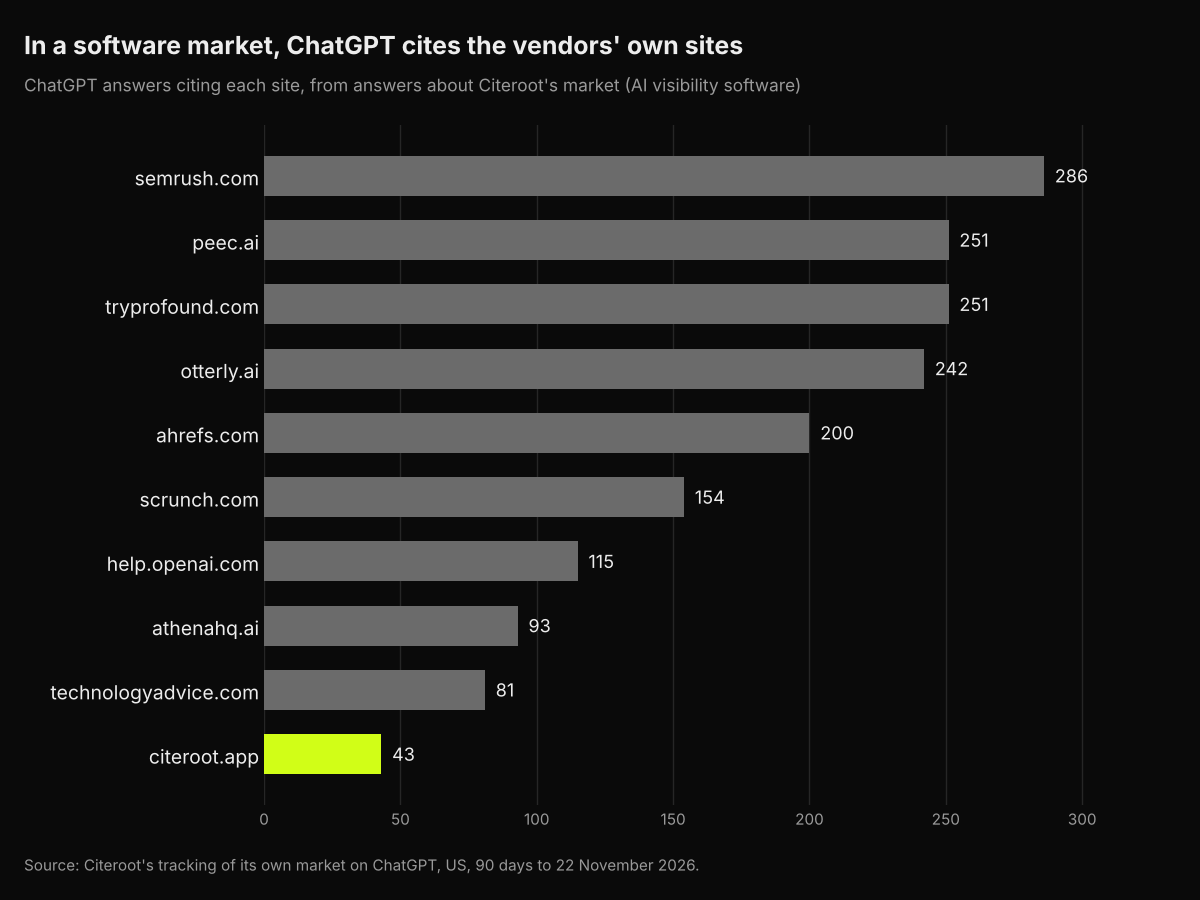
Seven of the eight most cited sites are competitors' own websites, cited because they publish guides, comparisons and explanations of the very questions buyers ask; the eighth is OpenAI's documentation. The chart also shows technologyadvice.com, a third-party roundup in tenth place, and citeroot.app in fourteenth with 43 answers; Google's developer documentation, ninth with 93, is left out for space. Our own site's low count matches how rarely ChatGPT names us on unbranded questions.
The lesson for any SaaS company: your own domain can be one of the most cited sources in your category, but only if it holds the pages buyers' questions need. These are one market's figures, so check your own market's sources before you copy the pattern.
#How to get your SaaS recommended by ChatGPT, step by step
The steps start with measurement, because a SaaS company that tests only branded questions will think it is doing better than it is.
#1. Track the unbranded questions
Write 20 to 50 questions a buyer asks before choosing: a problem ("how do I track which AI tools mention my brand"), a shortlist ("best tools for X"), a constraint ("for a team of five", "under $100 a month") and a comparison. In our data, ChatGPT named Citeroot in 43% of answers to comparison questions, some of which name Citeroot, and in none of the 448 answers to problem, shortlist and constraint questions. That gap is the work.
#2. Publish honest comparison and alternatives pages
Write pages that compare your product with each main competitor, and "alternatives to" pages for the competitors buyers already know. Use the competitors' own pricing pages as sources, with dates, state where they are the better choice, and say who your product suits. A page that only praises you is less likely to be quoted than one a buyer can trust.
#3. Make pricing and limits explicit
Put plan names, prices, limits and trial terms in plain text on your pricing page, and keep them current everywhere. Old terms linger: in answers collected on 21 November 2026, ChatGPT described Citeroot's paid plans as starting with a 14-day free trial, from an older version of our pricing page; the page now offers a 3-day trial of Grow.
#4. Write use-case and integration pages
Constraint questions name a team size, an industry, a budget or a tool to integrate with. Give each important use case and integration its own page that answers the question in the first paragraph, so ChatGPT has a page that matches the constraint.
#5. Get into the third-party roundups
List the third-party pages cited for your questions and ask to be included. In our market, zapier.com was cited in 224 answers across four platforms over 90 days and technologyadvice.com in 96, almost always alongside competitors and never alongside Citeroot. Those are the pitches that matter most for us; your list will differ.
#6. Keep your documentation crawlable
ChatGPT gave 7.5% of its citations to documentation pages in our data, more than any other platform. Make sure your help centre and docs are public, readable without JavaScript and not blocked from OAI-SearchBot; OpenAI's crawler overview says sites that block it "will not be shown in ChatGPT search answers".
#7. Claim your profile in Business Hub
OpenAI's Business Hub, launched in beta on 10 November 2026, lets a business claim its ChatGPT profile, and OpenAI says Business Agents are available to eligible ecommerce and online service businesses in the US with a website. Claiming gives no guarantee of visibility, but it keeps your details in your hands. Our guide to claiming your business in ChatGPT covers the steps.
#Common mistakes
- Testing only branded questions. "Is our product good?" will flatter you; "best tool for X" tells the truth.
- Publishing comparison pages that are adverts. One-sided pages give buyers and assistants little reason to trust them.
- Hiding prices behind a form. If your pricing is not on the page, ChatGPT will repeat someone else's version of it.
- Blocking docs from crawlers. Documentation is one of the page types ChatGPT cites.
- Chasing review sites first. In our data, review sites took 1.0% of ChatGPT's citations; editorial pages took 90.5%.
#Where Citeroot fits
Citeroot is a SaaS product with the same problem, so we built it for this job. It asks your buyer questions on ChatGPT, Gemini, Google AI Overviews and Google AI Mode, splits results by buyer stage so unbranded gaps are visible, lists the sites cited when competitors are named and you are not, and its agent drafts the comparison or use-case page a gap calls for, for you to approve. See the Answer Tracker.
#Frequently asked questions
#Do reviews on software review sites help with ChatGPT?
They help buyers, but in our data they played a small part in ChatGPT's citations: review sites took 1.0% of 4,953 citations across 10 markets. Editorial pages, including vendors' own guides and comparisons, took 90.5%.
#Should my "best tools" page include my own product?
Yes, if it is a genuine option, but explain the criteria and who each tool suits, and be honest about where competitors are stronger. A fair page is more useful to buyers and more likely to be cited.
#Does ChatGPT favour big software brands?
In our market, the established brands were named far more often: Semrush in 57% of 615 ChatGPT answers over 28 days, against 8% for Citeroot. Much of that comes from how widely they are written about, which is why third-party coverage and your own pages both matter.
#How long does it take for ChatGPT to start recommending a SaaS product?
There is no fixed timeline. New pages can be cited once they are crawled, while coverage on other sites and what models learn in training build over months. Track the same questions monthly.
#Next step
Write ten unbranded questions your buyers ask, run them in ChatGPT this week, and list every site it cites. Compare that list with the pages on your own site, and start with the comparison, pricing or use-case page you are missing. To have the questions tracked weekly on four AI platforms, start Citeroot's free plan.
#Sources
- OpenAI, Overview of OpenAI crawlers, read 22 November 2026.
- OpenAI, Setting up your business on ChatGPT, read 22 November 2026.
- Citeroot answer data: ChatGPT answers about Citeroot's own market (90 days and 28 days to 22 November 2026), 2,914 answers on four platforms for source gaps (90 days) and 1,277 ChatGPT answers across 10 markets (90 days).