On this page
- Key takeaways
- How does ChatGPT decide which brands to name?
- Where is ChatGPT visibility won? Our data
- How to improve brand visibility in ChatGPT, step by step
- 1. Let OAI-SearchBot read your pages
- 2. Put your key content in the HTML
- 3. Write pages for the questions asked before buyers know you
- 4. Back your claims with sources, figures and quotations
- 5. Get onto the pages ChatGPT already cites
- 6. Keep your brand facts the same everywhere
- 7. Measure by buyer stage, once a month
- Common mistakes
- Where Citeroot fits
- Frequently asked questions
- How long does it take to improve brand visibility in ChatGPT?
- Does ChatGPT use Bing or Google results?
- Do I need special markup or files for ChatGPT?
- Does claiming my business in ChatGPT improve visibility?
- Should I write different content for ChatGPT and Google?
- Next step
- Sources
To improve brand visibility in ChatGPT, make sure OpenAI's search crawler can read your pages, publish pages that answer buyers' unbranded questions with sources and figures, get your brand onto the articles and lists ChatGPT already cites, and keep your facts consistent everywhere. Then measure the same questions monthly, by buyer stage, to see what moved.
By Nadir Ali, founder of Citeroot. Updated 22 November 2026. OpenAI's documentation and published research are cited where they apply; the data comes from answers Citeroot collected, and each figure says how many answers, which platforms and which dates.
#Key takeaways
- ChatGPT answers from what its model learned in training and, when a question needs current information, from web pages it finds by searching. Your visibility depends on your own pages and on what other sites say about your market.
- OpenAI says sites that block its search crawler, OAI-SearchBot, are left out of ChatGPT search answers. In a 2024 study by Vercel and MERJ, OpenAI's crawlers did not run JavaScript, so your key content belongs in the page's HTML.
- In the GEO study (KDD 2024), citing sources, adding quotations and adding statistics raised a page's visibility in AI answers by 30% to 40%. Keyword stuffing did not help, and lower-ranked pages gained the most.
- In 615 ChatGPT answers about Citeroot's own market over 28 days, ChatGPT named Citeroot in 43% of comparison answers and 24% of purchase answers, which include questions that name Citeroot, and in none of the 448 problem, shortlist and constraint answers.
- Claiming your business in ChatGPT's Business Hub keeps your details current, but OpenAI says it does not guarantee more visibility.
#How does ChatGPT decide which brands to name?
ChatGPT names brands from two places: what its model learned in training, and the web pages it reads when it searches. OpenAI's help page on ChatGPT search says ChatGPT "will automatically search the web" when a question could benefit from it, that answers using search show inline citations, and that it may pass search queries to third-party search providers, naming Bing as an example.
The help page does not say how ChatGPT ranks the pages it finds. What you can influence is the same either way: whether your own pages can be read and answer the question well, and whether the articles, reviews and lists ChatGPT reads about your market mention you. Brand visibility in ChatGPT improves when both say the same clear thing about you.
#Where is ChatGPT visibility won? Our data
For a newer brand, ChatGPT visibility is won or lost on the questions buyers ask before they know its name. Citeroot tracks its own website on ChatGPT, and in the 28 days to 22 November 2026 it collected 615 ChatGPT answers in the US, split by the buyer's stage.
| Buyer stage | Kind of question | ChatGPT answers | Named Citeroot | Recommended Citeroot |
|---|---|---|---|---|
| Problem | How to solve a need | 214 | 0% | 0% |
| Shortlist | Which tools are best | 166 | 0% | 0% |
| Constraint | Options within a limit, such as a budget | 68 | 0% | 0% |
| Purchase | Prices, plans and whether a tool is good | 107 | 24% | 17% |
| Comparison | One tool against another | 60 | 43% | 42% |
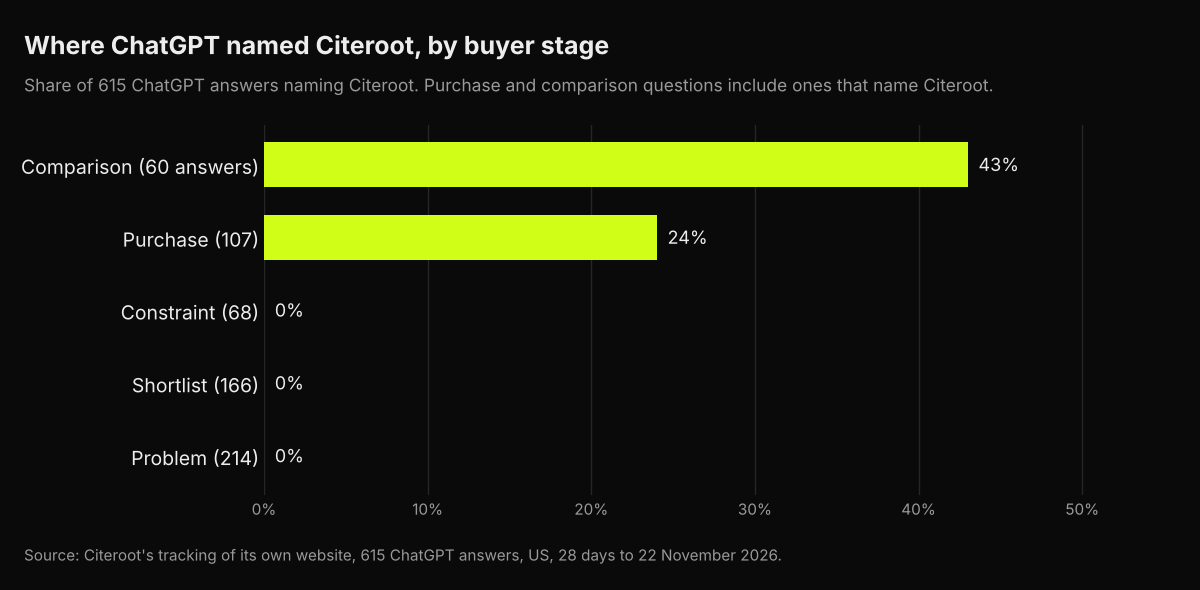
ChatGPT named Citeroot almost only when the buyer had already named it. The purchase and comparison questions include ones such as "is Citeroot good for tracking AI brand mentions", which ChatGPT answers by naming Citeroot first; the 448 answers to problem, shortlist and constraint questions, asked before a buyer has a brand in mind, never named it. Competitors filled that space: in the same 615 answers, ChatGPT named Semrush in 350, Profound in 338 and Peec AI in 318.
These figures describe one brand in one market, so treat them as a way to read your own data, not as a benchmark. They also show why a single visibility rate misleads: Citeroot's overall ChatGPT rate of 8% (52 of 615 answers) hides a 0% on the questions that bring new buyers.
#How to improve brand visibility in ChatGPT, step by step
The seven steps run from the technical basics to the slower work of earning mentions. Do them in order: earning links to a page ChatGPT cannot read is wasted effort.
#1. Let OAI-SearchBot read your pages
OpenAI's crawler overview names OAI-SearchBot as the crawler behind ChatGPT search and says sites that opt out of it "will not be shown in ChatGPT search answers", though they can still appear as navigational links. Check robots.txt for a rule that blocks it, then check your CDN, firewall and bot protection, which can block a crawler that robots.txt allows. GPTBot, which collects training data, is a separate setting; our guide to which AI crawlers to allow covers the rest.
Because ChatGPT may pass searches to providers such as Bing, check in Bing Webmaster Tools that Bing has indexed your important pages too. Our free AI crawler checker shows which AI crawlers your robots.txt admits.
#2. Put your key content in the HTML
Content that appears only after JavaScript runs may be invisible to OpenAI's crawlers. In Vercel and MERJ's study of AI crawler traffic, published in December 2024, "none of the major AI crawlers currently render JavaScript", OpenAI's OAI-SearchBot, ChatGPT-User and GPTBot included, and Vercel advised rendering critical content on the server.
Crawlers change, and the study is nearly two years old, so test your own pages. Load a key page with JavaScript turned off, or fetch it with a plain request, and check that the main text, prices and headings are in what comes back.
#3. Write pages for the questions asked before buyers know you
The questions that bring new customers are the unbranded ones, so give each kind a page. A problem question needs a guide that solves the problem and shows where your product fits. A shortlist question needs an honest "best for" page that explains the criteria and includes competitors. A constraint question needs a page for the budget, team size, industry or location it names. Comparison and "alternatives to" pages catch buyers who already know a competitor.
Open each page with a 40 to 60 word answer to its question, use the buyer's words in the headings, and state plainly what your product does, who it suits and what it costs. Our free buyer-prompt builder drafts the questions to write for.
#4. Back your claims with sources, figures and quotations
Evidence makes a page more likely to be used in AI answers. In GEO: Generative Engine Optimization (Aggarwal and colleagues, KDD 2024), citing sources, adding quotations and adding statistics "achieved a relative improvement of 30-40%" on the paper's main measure of how much of an AI answer came from a page. Keyword stuffing scored below the unedited pages.
The same paper found that lower-ranked pages gained most. For pages ranked fifth in the search results the engine read, citing sources raised visibility by 115.1%, while the top-ranked page lost visibility under the same changes. That is good news for smaller brands, but only real evidence counts: your own figures, customers who agreed to be named, and public sources you link.
#5. Get onto the pages ChatGPT already cites
ChatGPT builds its answers from the pages it reads, so your brand needs to be on them. Run your buyer questions, copy the sources each answer lists, and rank the sites by how many of your questions cite them. A mention on a page cited for ten of your questions is worth more than ten mentions on pages ChatGPT never reads.
For ChatGPT, editorial pages matter most. Across 1,000 ChatGPT answers with sources that Citeroot collected in 10 markets over 90 days, 90.5% of the 4,953 citations went to editorial pages such as articles, reviews and roundups, and under 1% to Reddit, YouTube or social sites. Ask the authors of the roundups that cite your competitors to consider you, with a reason their readers would care, and keep your profiles on review sites current.
#6. Keep your brand facts the same everywhere
When sources disagree about your prices or what you sell, ChatGPT can repeat any of them. Use the same name, one-line description, prices and locations on your website, profiles and listings, and update old pages when something changes. Old facts linger: in ChatGPT answers we collected on 21 November 2026, ChatGPT still described Citeroot's paid plans as starting with a 14-day free trial, while Citeroot's pricing page now offers a 3-day trial of Grow.
If ChatGPT lets you claim your business in its Business Hub, do it, so the details ChatGPT shows come from you. OpenAI's setup guide is clear that claiming "doesn't guarantee increased visibility", so treat it as housekeeping, not a ranking boost.
#7. Measure by buyer stage, once a month
Track a fixed list of 20 to 50 buyer questions, labelled by stage, and judge progress on the unbranded stages, not the overall rate. Compare each 28 days with the 28 days before, and count a change only when it is bigger than normal variation. Alongside, count visits in Google Analytics from the source chatgpt.com, which OpenAI's publishers FAQ says ChatGPT adds to its referral links as utm_source=chatgpt.com. Our guide to tracking brand mentions in ChatGPT sets out the weekly method.
#Common mistakes
- Judging progress on questions that name you. In our data, ChatGPT named Citeroot in 43% of comparison answers and 0% of problem answers; the branded rate flatters.
- Blocking OAI-SearchBot with a blanket AI-bot rule. Blocking every AI crawler to stop training also removes you from ChatGPT search answers.
- Hiding key content behind JavaScript. Prices, product details and answers that load only in the browser may never reach OpenAI's crawlers.
- Chasing Reddit for ChatGPT. In our data, Reddit was cited in 29% of Google AI Overview answers with sources but in under 1% of ChatGPT's.
- Stuffing keywords or inventing statistics. Keyword stuffing did not help in the GEO study, and a made-up figure is a risk to your reputation.
- Expecting Business Hub to lift visibility. Claiming keeps your details right, but OpenAI says it does not guarantee more visibility.
#Where Citeroot fits
Citeroot tracks your buyer questions on ChatGPT, Gemini, Google AI Overviews and Google AI Mode, and splits how often you are named, cited and recommended by platform and by buyer stage, which is how the chart above was made. Its Source Map shows the sites AI cites in your market and marks the ones cited in answers that name competitors but never you, and its agent drafts a page for a question where AI names others; you approve each one before it goes anywhere. The chart above is Citeroot's own: we are working through these same steps on our site, starting with the questions where we are named in none of the answers.
#Frequently asked questions
#How long does it take to improve brand visibility in ChatGPT?
There is no fixed timeline. Technical fixes such as unblocking OAI-SearchBot are the quickest to make, while new pages and third-party mentions take longer to be crawled and cited. Compare 28-day windows rather than single days.
#Does ChatGPT use Bing or Google results?
OpenAI's help page says ChatGPT may pass search queries to third-party search providers and names Bing as an example. It does not list them all, so make sure both Bing and Google can index your important pages.
#Do I need special markup or files for ChatGPT?
No. OpenAI's publishers FAQ says "Any public website can appear in ChatGPT search", and Google's guidance on AI features says its AI answers have no extra requirements beyond normal SEO best practice. Structured data that matches the visible page still helps machines read it, but it is not a switch.
#Does claiming my business in ChatGPT improve visibility?
Not directly. Claiming lets you keep your details current and see mentions and clicks, but OpenAI gives no guarantee of more visibility. Our guide to claiming your business in ChatGPT covers the steps.
#Should I write different content for ChatGPT and Google?
No. One page that answers the question, shows its evidence and can be crawled serves search engines and AI assistants alike, and it saves you keeping two versions of the same facts in step.
#Next step
Start with step 1 today: run your site through our free AI crawler checker, then ask ChatGPT ten unbranded buyer questions and note who is named instead of you. Citeroot's free plan checks five questions every week on ChatGPT, Gemini, Google AI Overviews and Google AI Mode, so you can see whether your changes move anything.
#Sources
- OpenAI, Overview of OpenAI crawlers, read 22 November 2026.
- OpenAI, ChatGPT search, read 22 November 2026.
- OpenAI, Publishers and developers FAQ, read 22 November 2026.
- OpenAI, Setting up your business on ChatGPT, read 22 November 2026.
- Vercel, The rise of the AI crawler, 17 December 2024.
- Aggarwal and colleagues, GEO: Generative Engine Optimization, KDD 2024.
- Google Search Central, AI features and your website, read 22 November 2026.
- Citeroot answer data: 615 ChatGPT answers about Citeroot's own market (US, 28 days to 22 November 2026) and 1,277 ChatGPT answers across 160 questions in 10 markets (90 days to 22 November 2026).