On this page
- Key takeaways
- What do you need to monitor Gemini?
- How is Gemini different from AI Overviews? Our data
- How to monitor Gemini by hand
- 1. Start a fresh chat for every question
- 2. Ask the question exactly as written
- 3. Record the answer and its links
- 4. Repeat on a schedule and compare
- Can Gemini use your pages?
- Which tools monitor Gemini?
- Common mistakes
- Where Citeroot fits
- Frequently asked questions
- Does Google Search Console show Gemini results?
- Will blocking Google-Extended remove me from AI Overviews?
- Is Gemini the same as Google AI Mode?
- How often should I check Gemini?
- Next step
- Sources
To monitor brand visibility in Gemini, you need a fixed set of buyer questions, a way to collect Gemini's answers, by hand or with a tracker that covers the Gemini app, and a log of whether each answer names, links to or recommends you. Google Search Console does not report Gemini, so track it separately from AI Overviews.
By Nadir Ali, founder of Citeroot. Updated 22 November 2026. Google's documentation is cited where it applies; the data comes from answers Citeroot collected, and each figure says how many answers, which platforms and which dates.
#Key takeaways
- Gemini is a separate product from Google's AI Overviews and AI Mode, and it cites sources differently. Across 10 markets over 90 days, Gemini cited no source in 16.4% of answers, against 5.0% for AI Mode and 3.5% for AI Overviews.
- Gemini leans on articles: 92.4% of its citations went to editorial pages, while AI Overviews gave 22.9% of citations to forums, video and social sites.
- Search Console's generative AI report covers AI Overviews and AI Mode, not the Gemini app, so Gemini needs its own checks.
- Access works differently too. Google says the Google-Extended setting controls whether your content is used for Gemini training and for grounding answers in Gemini Apps, without affecting Google Search.
- In Citeroot's own data, Gemini named Citeroot in 8% of 615 answers and recommended it in 5%, more than Google AI Overviews' 2%, but never on unbranded problem, shortlist or constraint questions.
#What do you need to monitor Gemini?
Monitoring Gemini needs five things, most of which you already have if you track ChatGPT. The difference is that Gemini must be checked on its own, because Google's search reports do not include it.
- A fixed question set: 20 to 50 questions a buyer asks before choosing, most of them without your brand name, with the wording frozen from month to month.
- A collection method: asking each question in the Gemini app by hand, or a tracker that collects Gemini answers on a schedule.
- A coding sheet: for each answer, whether you were named, linked and recommended, your position, and who else was named.
- An access check: your robots.txt settings for Googlebot and Google-Extended.
- A reporting rhythm: monthly 28-day windows, with rates and sample sizes per platform.
#How is Gemini different from AI Overviews? Our data
Gemini, AI Mode and AI Overviews all come from Google, but they cite the web in different ways. Citeroot collected 3,250 answers from the three surfaces in the 90 days to 22 November 2026, for up to 160 questions across 10 markets.
| Surface | Answers | Citing no source | Citations to editorial pages | Citations to forums, video and social |
|---|---|---|---|---|
| Gemini | 1,212 | 16.4% | 92.4% | 5.8% |
| Google AI Mode | 1,151 | 5.0% | 75.9% | 19.9% |
| Google AI Overviews | 887 | 3.5% | 75.5% | 22.9% |
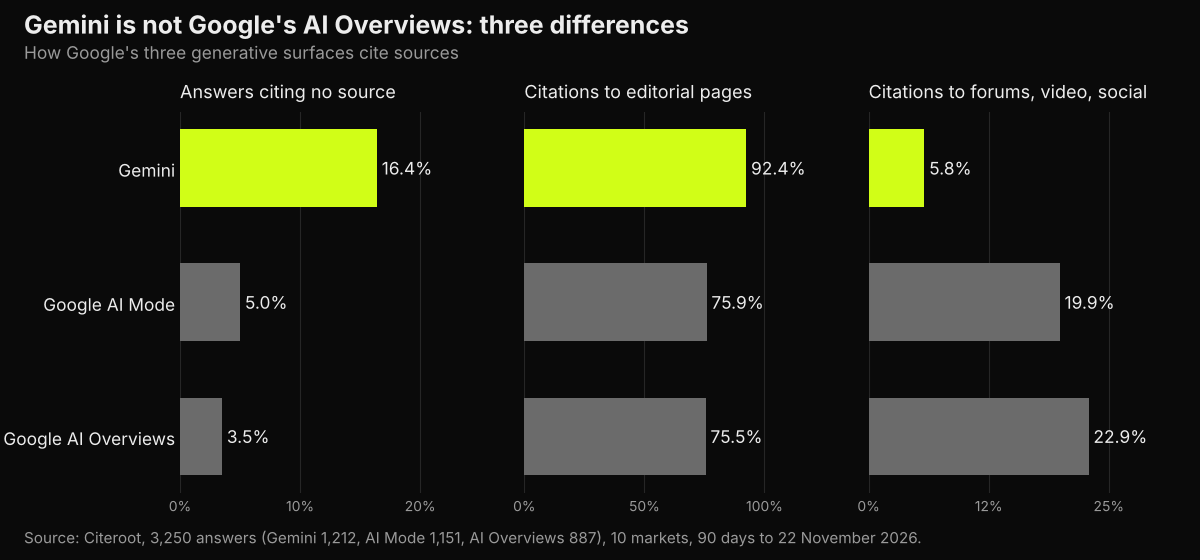
Gemini answered without any source about one time in six, far more often than Google's search features, so some of its answers rest on what the model already knows. When it did cite sources, it chose articles, reviews and guides over YouTube, Facebook and forums. The one exception was reddit.com, Gemini's most cited site, in 16.3% of answers with sources across eight of the ten markets.
For your own brand, the results can differ too. Citeroot tracks its website on all four platforms; in the 28 days to 22 November 2026, Gemini named Citeroot in 52 of 615 answers (8%), linked to citeroot.app in 49 (8%) and recommended it in 33 (5%). Google AI Overviews recommended it in 2% of 442 answers. On questions asked before a buyer has a brand in mind, none of the four platforms named Citeroot.
#How to monitor Gemini by hand
A monthly check by hand takes about an hour for 20 questions. Keep the routine identical each time so the months compare.
#1. Start a fresh chat for every question
Start a new chat for each question, so the answer is not shaped by an earlier one. If you are signed in, use an account with no past conversations on the topic.
#2. Ask the question exactly as written
Type each question word for word from your list, without adding your brand name. For local questions, include the city, as a buyer would.
#3. Record the answer and its links
Note whether you were named, linked and recommended, your position, and every other brand named. Copy any links Gemini shows; they show which pages it relied on, and an answer with no links tells you it answered from what the model already knew.
#4. Repeat on a schedule and compare
Ask the full set once a month and calculate each rate, with the number of answers it is based on. Treat a change of a few points on 20 questions as noise until it holds for two or three months.
#Can Gemini use your pages?
Gemini can only cite your pages if Google can crawl them and you have not opted out of Gemini's use of them. Google's crawler documentation describes Google-Extended as a robots.txt token that controls whether content Google crawls may be used to train future Gemini models and to ground answers in Gemini Apps and the Vertex AI API, as Search Engine Journal reported. The same documentation says Google-Extended does not affect a site's inclusion or ranking in Google Search.
That makes Gemini the one Google surface you can leave without leaving Search. Check your robots.txt for a User-agent: Google-Extended group with Disallow: /; if it is there and you want Gemini to cite you, remove it. Our free AI crawler checker shows how your robots.txt treats Google-Extended and the other AI crawlers.
#Which tools monitor Gemini?
Several AI visibility trackers include Gemini on their entry plans, according to their pricing pages on 22 November 2026: Citeroot (every plan, including Free), Ahrefs, SE Ranking, Semrush's AI Visibility Toolkit, HubSpot AEO and AthenaHQ's free plan. Our AI visibility tool pricing guide compares what each plan costs per answer.
#Common mistakes
- Assuming AI Overviews data covers Gemini. They are separate products, and Search Console reports only the search features.
- Blocking Google-Extended by accident. A blanket block on AI tokens removes your content from Gemini's grounding while leaving Search untouched, so the loss is easy to miss.
- Chasing video for Gemini. Video took 0.4% of Gemini's citations in our data, against 9.0% in AI Overviews.
- Testing questions that name you. They make Gemini look friendlier than it is to new buyers.
- Reading one month as a trend. Gemini's answers change from run to run; compare several 28-day windows.
#Where Citeroot fits
Citeroot asks your buyer questions in the Gemini app alongside ChatGPT, Google AI Overviews and Google AI Mode, on a fixed schedule, and stores every answer with its links. It shows named, cited and recommended rates per platform and by buyer stage, with a range on each, so you can see how Gemini differs from Google's search features for your own brand. See the Answer Tracker.
#Frequently asked questions
#Does Google Search Console show Gemini results?
No. Search Console's generative AI report covers impressions in AI Overviews and AI Mode, plus a separate report for Discover. Gemini app answers need their own tracking.
#Will blocking Google-Extended remove me from AI Overviews?
Google says Google-Extended does not affect a site's inclusion or ranking in Google Search, and AI Overviews and AI Mode are part of Search. Blocking it stops your content being used to ground Gemini Apps answers and to train future Gemini models.
#Is Gemini the same as Google AI Mode?
No. Both come from Google, but in our data Gemini cited no source in 16.4% of answers against 5.0% for AI Mode, and AI Mode gave forums, video and social sites more than three times Gemini's share of citations.
#How often should I check Gemini?
Monthly is enough for a baseline, using the same questions each time. Weekly or daily collection helps when you are changing pages and want to see what moved.
#Next step
Check your robots.txt for Google-Extended today, then ask Gemini ten of your buyers' questions and log who is named and which links appear. Citeroot's free plan checks five questions every week on Gemini, ChatGPT and Google's two AI search features, and our guide to tracking recommendations in Google generative search covers the search side.
#Sources
- Search Engine Journal, Google Updates Gemini/Vertex AI User Agent Documentation, 2025.
- Google, List of Google's common crawlers, read 22 November 2026.
- Google Search Central Blog, Introducing Search Generative AI performance reports in Search Console, 3 June 2026.
- Vendor pricing pages, read 22 November 2026, as listed in our AI visibility tool pricing guide.
- Citeroot answer data: 3,250 answers from Gemini, Google AI Mode and Google AI Overviews across 10 markets (90 days to 22 November 2026) and 2,257 answers about Citeroot's own market on four platforms (US, 28 days to 22 November 2026).