On this page
- Key takeaways
- Does a small business need an AI visibility tool?
- Which AI visibility tools suit a small business?
- Who each tool suits
- Citeroot
- Otterly.AI
- HubSpot AEO
- Semrush AI Visibility Toolkit
- Ahrefs
- SE Ranking
- Peec AI
- AthenaHQ
- What does AI itself recommend? Our data
- What if your business has no website?
- Which tools check Google AI Overviews and AI Mode?
- How many questions does a small business need?
- Common mistakes
- Where Citeroot fits
- How we compared
- Frequently asked questions
- What is the best free AI visibility tool for a small business?
- What is the cheapest paid AI visibility tool?
- Can I track AI visibility without a website?
- Does Citeroot track Perplexity or Claude?
- How often should a small business check AI answers?
- Next step
- Sources
Most small businesses should start free and pay only once they know which customer questions matter. Citeroot and AthenaHQ have free plans, Otterly.AI Lite is the cheapest paid tracker we checked at €29 a month, and businesses already paying for Semrush or Ahrefs should try the AI reports they have first.
By Nadir Ali, founder of Citeroot. Updated 22 November 2026. We build Citeroot, so weigh that: it is in the table below, not at the top of a ranking. Every price was read from the vendor's own pricing page on 22 November 2026. For enterprise tools and the full field, see our comparison of AI visibility tools.
#Key takeaways
- A first check costs nothing: ask 15 to 20 customer questions by hand in ChatGPT and Google, write down who is named, and repeat once a month.
- Of the paid plans we checked on 22 November 2026, Otterly.AI Lite is the cheapest at €29 a month for 16 prompts checked daily. HubSpot AEO is $50 a month for 25 prompts.
- Citeroot (5 questions checked weekly) and AthenaHQ (300 credits) have free plans. Citeroot's free plan covers ChatGPT, Gemini, Google AI Overviews and Google AI Mode.
- When buyers ask AI which visibility tool to use, Profound was named in 46% of 2,187 answers Citeroot collected, yet its pricing page now lists only custom enterprise plans. AI's own shortlist leans towards tools priced for bigger teams.
- Small samples are noisy. In Otterly.AI's study of 252,407 answers, 10 prompts gave brand coverage results anywhere from 39% to 71%, against 51% to 60% with 100 prompts.
- A local business with no website can still be tracked: Citeroot can start a project from a Google Business Profile link.
#Does a small business need an AI visibility tool?
A small business does not need an AI visibility tool on day one. A first check by hand takes about half an hour and shows whether AI names you at all, which is the only thing worth knowing before you spend money.
Write 15 to 20 questions a customer would really ask, such as "best plumber in Austin", "alternatives to Mailchimp for a bakery" or "cheapest wedding photographer in Lahore". Our free buyer-prompt builder can draft a balanced set for your category. Ask each question in ChatGPT with search on and in Google, then write down every business named, the order they appear in, and every link shown under the answer.
Repeat the check once a month. A tool earns its place when you want the same questions asked every day, on several AI engines, with the history kept for you, so you can see whether a change you made moved anything.
#Which AI visibility tools suit a small business?
Eight tools pass our test for a small business: each has a free plan, or a first paid plan under $150 a month that you can buy without talking to sales. The table compares what you get on the first plan you would actually use.
| Tool | Free option | First paid plan | Questions tracked | AI engines on that plan | Suits |
|---|---|---|---|---|---|
| Citeroot | Free plan: 5 questions, checked weekly | Grow: $59/mo, or $49/mo billed yearly | 30, checked daily | ChatGPT, Gemini, Google AI Overviews, Google AI Mode | Local and small brands that want Google's AI answers and ChatGPT in one place, including businesses without a website |
| Otterly.AI | Free trial | Lite: €29/mo | 16, checked daily | 4 of 7 you choose | The cheapest paid daily tracking |
| HubSpot AEO | 28-day free trial | $50/mo, or $45/mo paid yearly | 25 | ChatGPT, Perplexity, Gemini | Teams already working in HubSpot |
| Semrush AI Visibility Toolkit | No free trial for the toolkit, per Semrush's help page | $99/mo per domain, billed annually | 25, checked daily | ChatGPT, Google AI, Gemini, Perplexity | Existing Semrush customers |
| Ahrefs | Not listed for AI tracking | Lite: $129/mo with 5 tracked prompts; Custom Prompts from $50/mo | 5 on Lite | AI Overviews, AI Mode, ChatGPT, Copilot, Gemini, Perplexity, Claude | Existing Ahrefs customers |
| SE Ranking | 14-day trial, no card | Core: $129/mo, or $103.20/mo billed yearly | 25, checked daily | ChatGPT, Copilot, Google AI Overviews, AI Mode, Gemini | Small teams that also need a classic SEO suite |
| Peec AI | Free trial (length not stated) | Starter: $95/mo | 50, checked daily | 3 you choose | Marketers who want a focused analytics tool |
| AthenaHQ | Free plan: 300 credits | Starter: $295/mo | 3,600 credits | Free plan: ChatGPT, Perplexity, Google AI Overviews, Gemini, Copilot | Trying wide engine coverage at no cost |
For what drives these prices, see our AI visibility tool pricing guide. Prices are as shown on each vendor's page on 22 November 2026 and exclude tax where the vendor says so. Otterly.AI shows euro prices on its plan cards, while its page summary quotes $29. Sources: Citeroot, Otterly.AI, HubSpot AEO, Semrush and its toolkit help page, Ahrefs pricing and Brand Radar, SE Ranking plans and AI tracker, Peec AI and AthenaHQ.
#Who each tool suits
Each tool below is described from its own pricing page and the plan a small business would start on. The right one depends less on features than on where your customers ask and what you already pay for.
#Citeroot
Citeroot tracks ChatGPT, Gemini, Google AI Overviews and Google AI Mode on every plan, including the free one, and stores each full answer with the sites it cites. A project can be one city, and a business without a website can start from its Google Business Profile. Citeroot is new: it does not track Perplexity or Claude on its self-serve plans, and AI names it in few answers today.
#Otterly.AI
Otterly.AI Lite is the cheapest paid plan we found, at €29 a month for 16 prompts checked daily. You choose 4 of its 7 engines, so a local business can pick Google AI Overviews and AI Mode alongside ChatGPT. Otterly.AI also publishes a steady stream of its own experiments, which are worth reading whichever tool you pick.
#HubSpot AEO
HubSpot AEO costs $50 a month for 25 prompts across ChatGPT, Perplexity and Gemini, with a 28-day free trial that HubSpot says needs no HubSpot subscription. It makes most sense if your contacts and marketing already live in HubSpot. It does not list Google AI Overviews or AI Mode, which matter for local searches.
#Semrush AI Visibility Toolkit
The Semrush AI Visibility Toolkit is $99 a month per domain, billed annually, for 25 prompts across ChatGPT, Google AI, Gemini and Perplexity, and Semrush's help page says the toolkit has no free trial. If you already use Semrush for keywords, adding the toolkit keeps everything in one place.
#Ahrefs
Ahrefs includes prompt tracking from its Lite plan at $129 a month, with 5 tracked prompts and 150 checks a month, and sells Custom Prompts from $50 a month. Its Custom Prompts cover both Google AI features as well as ChatGPT, Copilot, Gemini, Perplexity and Claude, though each Claude check uses eight of your checks. It suits businesses already paying for Ahrefs rather than buying it for AI tracking alone.
#SE Ranking
SE Ranking's Core plan, at $129 a month or $103.20 billed yearly, includes AI visibility tracking for 25 prompts daily across five engines, with a 14-day trial and no card. It is the better buy if you also want rank tracking and site audits.
#Peec AI
Peec AI Starter is $95 a month for 50 prompts checked daily on 3 engines you choose. It is a focused analytics product for a marketer who will read the data every week.
#AthenaHQ
AthenaHQ gives a free plan of 300 credits across five engines, then jumps to $295 a month for its Starter plan. Use the free plan to see how answers differ across engines; the paid plan is priced for larger teams.
#What does AI itself recommend? Our data
When buyers ask AI assistants which visibility tool to use, the answers lean towards tools built for larger companies. Citeroot collected 2,187 answers from ChatGPT, Gemini, Google AI Overviews and Google AI Mode in the United States, in the 28 days to 21 November 2026, to the buyer questions we track about AI visibility tools.
| Tool | Answers naming it | Share of 2,187 |
|---|---|---|
| Semrush | 1,113 | 51% |
| Profound | 1,016 | 46% |
| Ahrefs | 866 | 40% |
| Peec AI | 863 | 39% |
| Otterly.AI | 728 | 33% |
| SE Ranking | 406 | 19% |
| Scrunch AI | 351 | 16% |
| Writesonic | 195 | 9% |
| Citeroot | 184 | 8% |
Source: Citeroot, 2,187 answers, 28 days to 21 November 2026. One answer can name several tools.
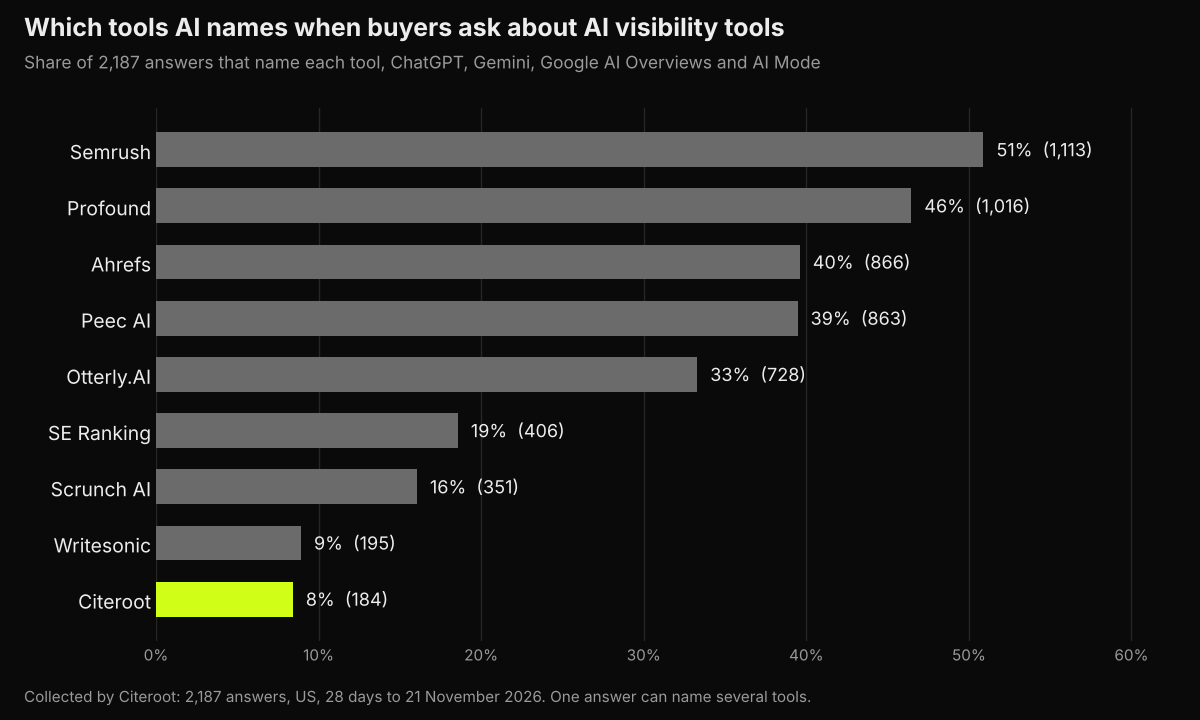
Profound is the second most named tool, yet its pricing page now lists a single custom Enterprise plan and says its Starter and Growth plans for brands were retired in September 2026. Scrunch AI, named in 16% of answers, starts at $250 a month. A small business owner who asks ChatGPT "which tool should I use?" will often be pointed at tools priced for a marketing department.
Our own result is part of the picture. Citeroot was named in 184 of the 2,187 answers (8%), almost all of them answers to comparison and purchase questions, several of which name Citeroot. On the 1,575 answers to problem, constraint and shortlist questions, where the buyer has not picked a tool yet, Citeroot's share rounds to 0%. These counts describe one market, AI visibility tools in the US, and are not a finding about AI answers in general.
The same data shows where the answers come from. Over 90 days, reddit.com was cited in 638 of 2,778 answers and youtube.com in 450. A tool that shows the cited sites in your own market tells you which forums, directories and review sites to work on.
#What if your business has no website?
A business without a website can still be checked and tracked. Many local businesses, tradespeople, artists and performers live on a Google Business Profile, Instagram and word of mouth, and AI assistants still answer questions about them.
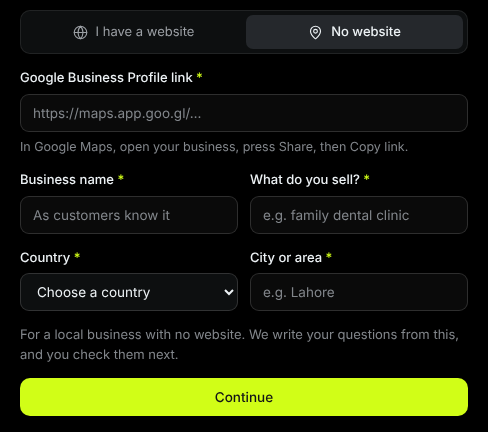
Citeroot can start a project from a Google Business Profile link instead of a website. In Google Maps you open your business, press Share and copy the link, then add your business name, what you sell, your country and your city. Citeroot writes your first questions from that, and you check them before the first run.
The profile itself is worth keeping in order. Google's own Business Profile help says local results depend mainly on relevance, distance and prominence, and that a profile with "complete and accurate info" gives a business a better chance of appearing in them. For ChatGPT, our guide to claiming your business in ChatGPT covers the Business Hub listing, and how to get ChatGPT to recommend your local business covers the rest of the work.
#Which tools check Google AI Overviews and AI Mode?
Google AI Overviews appear at the top of Google's results page and AI Mode is a tab inside Google Search, so a local business should make sure its tool checks both. Citeroot includes both on every plan, including Free. Ahrefs and SE Ranking list both. Otterly.AI and Peec AI include them if you choose them as one of your engines. HubSpot AEO does not list them.
Google says there is nothing special to do to appear. Its guidance on AI features states that "there are no additional requirements to appear in AI Overviews or AI Mode", and that a page can be shown as a supporting link if it is indexed and eligible to appear in Search with a snippet. A tool cannot change that; it shows whether your pages and profile are turning up.
#How many questions does a small business need?
A handful of questions is enough for a baseline, not for a score. AI answers change from one run to the next, and a small sample moves a lot on its own.
Otterly.AI measured this across 252,407 answers from seven engines in its September 2026 study. With 10 prompts, 90% of brand coverage results fell between 39% and 71%; with 100 prompts the range narrowed to 51% to 60%. On a free plan with 5 questions, or a paid plan with 16 to 30, read the direction over several weeks rather than one week's number.
Citeroot shows each rate with its range and calls a change up or down only when it is bigger than normal variation. Whatever tool you use, ask how it handles that noise before you trust a weekly chart.
#Common mistakes
- Buying before writing your questions. The questions are the product. Without the 15 to 20 your customers really ask, any tool tracks the wrong thing.
- Tracking questions that name you. A question that contains your business name is answered from your own site and makes visibility look higher than it is. Track the questions where a customer has not chosen yet.
- Judging one run. With a small set of questions, results can swing by more than 30 points on their own, as the Otterly.AI study above shows. Compare weeks, not days.
- Skipping Google's AI for a local business. Customers searching for a local service often start in Google, and Google's AI answers sit on that same results page.
- Expecting the tool to do the work. A tracker measures. The work is letting AI crawlers read your site, describing what you do the same way everywhere, and getting named on the sites AI already cites.
#Where Citeroot fits
Citeroot is built for a small brand or local business that wants ChatGPT and Google's AI answers in one place. The free plan checks 5 questions a week on four engines with no card; Grow adds 30 questions checked daily for $49 a month billed yearly, with a 3-day trial. Each answer is stored with its cited sources, a project can be one city, and a business without a website can start from its Google Business Profile. It does not cover Perplexity or Claude on its self-serve plans. See pricing and the Answer Tracker.
#How we compared
We listed tools a small business can sign up for without talking to sales, with a free plan or a first paid plan under $150 a month. For each, we read the vendor's own pricing page on 22 November 2026 and recorded the free option, the first paid price, the number of questions tracked and the AI engines on that plan. We left out Profound, which lists only custom Enterprise pricing, and Scrunch AI, whose first plan is $250 a month. Prices change often, so check before you buy.
#Frequently asked questions
#What is the best free AI visibility tool for a small business?
Citeroot Free checks 5 questions a week on ChatGPT, Gemini, Google AI Overviews and Google AI Mode, with no card. AthenaHQ's free plan gives 300 credits across five engines. Both are enough for a baseline, and neither replaces a monthly check by hand of your most important questions.
#What is the cheapest paid AI visibility tool?
Otterly.AI Lite is the cheapest we found on 22 November 2026, at €29 a month for 16 prompts checked daily on 4 engines you choose. HubSpot AEO is next at $45 a month paid yearly, and Citeroot Grow is $49 a month paid yearly.
#Can I track AI visibility without a website?
Yes. Citeroot can start a project from a Google Business Profile link, with your business name, what you sell and your city. You can also check by hand by asking ChatGPT and Google the questions your customers ask.
#Does Citeroot track Perplexity or Claude?
Not on its self-serve plans. Citeroot tracks ChatGPT, Gemini, Google AI Overviews and Google AI Mode, and its pricing page says Enterprise can add platforms such as Claude and Perplexity on request.
#How often should a small business check AI answers?
Monthly by hand is enough to start. Daily tracking helps once you are changing pages, profiles or listings and want to see what moved, and even then read the trend over several weeks.
#Next step
Write down five questions your customers ask and see who AI names today. If you want those checked every week on ChatGPT, Gemini and Google's AI answers at no cost, start on Citeroot's free plan, with your website or your Google Business Profile.
#Sources
- Google Search Central, AI features and your website, last updated 10 December 2025.
- Google Business Profile Help, Tips to improve your local ranking on Google.
- Otterly.AI, We measured how stable AI citations and brand mentions really are, September 2026.
- Semrush, AI Visibility Toolkit help page, read 22 November 2026.
- Vendor pricing pages linked under the comparison table, read on 22 November 2026.