On this page
- Key takeaways
- What is a GEO tool, and what is a GEO platform?
- Which GEO tools does AI recommend? Our data
- GEO tools and platforms compared
- Which GEO platforms help you act, not only measure?
- How to choose a GEO tool
- The GEO tools in brief
- Profound
- Semrush AI Visibility Toolkit
- Peec AI
- Ahrefs Brand Radar
- Otterly.AI
- Writesonic
- Scrunch
- AthenaHQ
- Citeroot
- Frequently asked questions
- What is the difference between a GEO tool and an SEO tool?
- Which GEO tool is best for an enterprise?
- Which GEO tool is cheapest?
- Can a GEO tool guarantee that AI will cite me?
- Do I need a GEO tool to do GEO?
- Next step
- Sources
The generative engine optimisation (GEO) tools and platforms AI names most are Profound, Semrush, Peec AI, Ahrefs, Otterly.AI and Writesonic. They split into trackers that measure where AI names you and platforms that also help you act, with entry prices from €29 a month (Otterly.AI) to custom enterprise contracts (Profound).
By Nadir Ali, founder of Citeroot. Updated 22 November 2026. We build Citeroot, one of the tools compared, so weigh that. Every price and feature was read from the vendor's own pricing page on 22 November 2026. For AI visibility trackers ranked for small budgets, see the best AI visibility tools for small businesses.
#Key takeaways
- In 262 AI answers to "compare generative engine optimization tools" and "top generative engine optimization platforms", collected by Citeroot, Profound was named in 97%, Semrush in 89%, Peec AI in 88%, Ahrefs in 80%, Otterly.AI in 79% and Writesonic in 57%. Citeroot was named in none.
- GEO tools differ most on what they do after measuring: Scrunch includes 10 citation targets and 10 generated pages a month, Writesonic bundles an article writer, AthenaHQ and Profound run content agents, and Citeroot's agent drafts and publishes articles.
- Entry prices run from €29 a month (Otterly.AI Lite) and $59 (Citeroot Grow) to $250 (Scrunch Core) and $295 (AthenaHQ Starter). Profound sells only custom Enterprise contracts.
- Engine coverage on entry plans ranges from 3 (Peec AI, Writesonic) to 8 (Scrunch) and 11 (AthenaHQ Starter).
- The research that named the field found that GEO methods "can boost visibility by up to 40% in generative engine responses" (Aggarwal and colleagues, KDD 2024).
#What is a GEO tool, and what is a GEO platform?
A GEO tool measures how AI assistants such as ChatGPT, Gemini and Google AI Overviews answer your buyers' questions, and whether they name, cite or recommend you. Generative engine optimisation is the work of earning those mentions; the term comes from a 2023 paper by Aggarwal and colleagues, accepted to KDD 2024, which found that GEO methods can raise a source's visibility in generative engine answers by up to 40%.
Vendors use "tool" and "platform" for the same products. The useful split is between monitoring and action. A tracker asks your questions on a schedule and shows who AI names and which sites it cites. A platform adds help with the fix: drafting content, finding the pages AI cites, or reaching out to them. Our guide to generative engine optimisation covers the work itself.
#Which GEO tools does AI recommend? Our data
AI assistants give a consistent list when asked to compare GEO tools, led by Profound. Citeroot collected 128 answers to "compare generative engine optimization tools" and 134 answers to "top generative engine optimization platforms" from ChatGPT, Gemini, Google AI Overviews and Google AI Mode in the United States, up to 22 November 2026.
| Tool | Answers naming it (of 262) | Share |
|---|---|---|
| Profound | 254 | 97% |
| Semrush | 234 | 89% |
| Peec AI | 230 | 88% |
| Ahrefs | 210 | 80% |
| Otterly.AI | 206 | 79% |
| Writesonic | 150 | 57% |
| Citeroot | 0 | 0% |
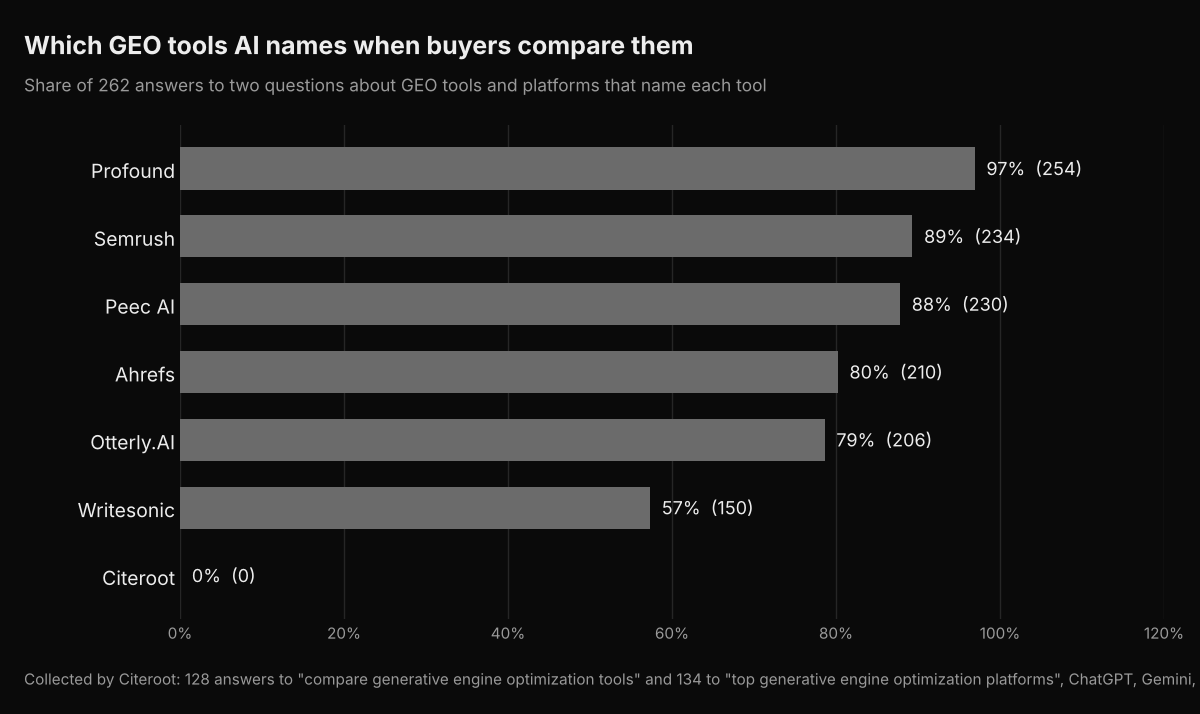
The most quoted website in both sets of answers was tryprofound.com, in 40 and 51 answers. Other frequently quoted sites were otterly.ai, semrush.com and peec.ai for the first question, and geotoolbox.ai, sitepoint.com and beomniscient.com for the second. Vendors' own comparison pages are among the most quoted sources, and the vendor quoted most, Profound, is also the one named most, even though it publishes no price. These counts describe two questions in one market, the US, so read them as a pattern rather than market share.
#GEO tools and platforms compared
The table lists each tool's first plan you can buy, its engines and the action features its vendor lists beyond tracking. Tools are ordered by how often AI named them in our data, with Scrunch, AthenaHQ and Citeroot after the six AI named.
| Tool | First paid plan | AI engines on that plan | Action features the vendor lists |
|---|---|---|---|
| Profound | Enterprise only, custom | Up to 10, including Perplexity, Claude and DeepSeek | AI Marketer agents, Context Manager, Agent Analytics, ChatGPT Shopping |
| Semrush AI Visibility Toolkit | $99/mo per domain, billed annually | ChatGPT, Google AI, Gemini, Perplexity | Part of the Semrush SEO toolset |
| Peec AI | Starter: $95/mo, 50 prompts | 3 of 8 you choose | Citation share and source classification, SKU-level shopping tracking |
| Ahrefs Brand Radar | Custom prompts from $50/mo for 2,500 checks | Google AI Overviews, AI Mode, ChatGPT, Perplexity, Gemini, Copilot | Part of the Ahrefs SEO toolset |
| Otterly.AI | Lite: €29/mo, 16 prompts | 4 of 7 | Content audit and briefs, recommendations, agent analytics from Standard |
| Writesonic | Starter: $79/mo billed yearly, 50 prompts | ChatGPT, Gemini, Google AI Overviews | AI article writer, SEO audits with AI fixes |
| Scrunch | Core: $250/mo, 15,000 responses | 8, including Perplexity, Copilot, Grok and Meta AI | 10 citation targets, 10 optimised and 10 generated pages a month |
| AthenaHQ | Starter: $295/mo, 3,600 credits | 11, including Claude and DeepSeek | Content optimisation agent, prompt volume estimates |
| Citeroot | Grow: $59/mo ($49 billed yearly), 30 questions | ChatGPT, Gemini, Google AI Overviews, AI Mode | Agent drafts and publishes articles, Source Map, site audit of 20 AI crawlers |
Sources: Profound, Semrush, Peec AI, Ahrefs, Otterly.AI, Writesonic, Scrunch, AthenaHQ and Citeroot, all read on 22 November 2026. For cost per answer and every plan ladder, see our AI visibility tool pricing guide.
#Which GEO platforms help you act, not only measure?
GEO platforms differ most in what happens after the chart. Monitoring tells you where you are missing; action features turn that into work you can ship. The vendors' own pages show four kinds of action.
- Content drafting. Writesonic bundles an AI article writer, AthenaHQ includes a content optimisation agent, Profound runs AI Marketer agents on credits, and Citeroot's agent drafts articles for the questions where AI leaves you out and publishes them to WordPress, Shopify or a webhook.
- Citation outreach. Scrunch's Citation Optimization, launched on 12 November 2026, scores the third-party pages AI cites and drafts outreach to their authors, with 10 targets a month on Core.
- Content audits and recommendations. Otterly.AI includes a content audit, content briefs and recommendations; Writesonic includes SEO audits with AI fixes.
- Crawler and agent analytics. Otterly.AI shows how AI agents crawl your site from its Standard plan, Profound's Agent Analytics connects to services such as Cloudflare and Vercel, and Citeroot's site audit checks which of 20 AI crawlers your robots.txt admits.
Action features do not replace judgement. Every drafted page still needs a person who knows the business to check it, and none of these tools can guarantee that AI will cite you.
#How to choose a GEO tool
Choose in this order: where your buyers ask, how much data you need, and what you want done with it.
- List the engines your buyers use. If Perplexity, Claude or Copilot matter, rule out tools that do not cover them on the plan you can afford.
- Count the questions you need. Twenty to fifty buyer questions is a sensible start; Otterly.AI's study of 252,407 answers found results with 10 prompts ranged from 39% to 71% brand coverage, against 51% to 60% with 100.
- Check that you can see the sources. The cited sites are where the work happens, so the tool should show which pages AI quotes for each question.
- Decide how much action you want. Pick a tracker if your team will do the work, or a platform with drafting or outreach if it will not.
- Match the budget and your stack. Already paying for Semrush or Ahrefs? Try their AI modules first. Otherwise, compare entry plans by cost per answer.
#The GEO tools in brief
Each tool below is described from its own pricing page, with the team it suits best.
#Profound
Profound sells only custom Enterprise contracts, after retiring its Starter and Growth plans in September 2026. Enterprise covers up to 10 answer engines, unlimited seats, SSO/SAML and SOC 2, an API, AI Marketer agents and Agent Analytics. It suits large marketing teams with a procurement process.
#Semrush AI Visibility Toolkit
The Semrush AI Visibility Toolkit costs $99 a month per domain, billed annually, for 25 prompts tracked daily across ChatGPT, Google AI, Gemini and Perplexity. It suits SEO teams that want AI visibility next to their keyword data.
#Peec AI
Peec AI Starter is $95 a month for 50 prompts on 3 engines you choose, with unlimited seats, SOC 2 on every plan, citation share and source classification, and SKU-level shopping tracking. Pro is $245 and Advanced $495. It suits mid-sized teams that want a focused tracker with many logins.
#Ahrefs Brand Radar
Ahrefs includes custom prompt checks in its paid plans and sells packages from $50 a month for 2,500 checks, with the full Brand Radar AI platform at $699 a month. It tracks Google AI Overviews, AI Mode, ChatGPT, Perplexity, Gemini and Copilot. It suits teams already on Ahrefs.
#Otterly.AI
Otterly.AI Lite is €29 a month for 16 prompts on 4 of 7 engines, with unlimited brands and team members, a content audit, content briefs and recommendations. Standard (€189) adds API, MCP and agent analytics. It suits small teams and agencies on a budget.
#Writesonic
Writesonic Starter is $79 a month billed yearly for 50 prompts and 150 answers a day on ChatGPT, Gemini and Google AI Overviews, bundled with its article writer and SEO audits. Enterprise tracks eight platforms. It suits content teams that want writing and tracking in one subscription.
#Scrunch
Scrunch Core is $250 a month for 15,000 responses across eight engines, with 5 seats, 10 citation targets, 10 optimised pages and 10 generated pages a month. Sitecore acquired Scrunch in June 2026. It suits one brand that wants tracking and outreach together.
#AthenaHQ
AthenaHQ has a free Essential plan with 300 credits, then Starter at $295 a month for 3,600 credits across 11 models, with unlimited seats, a content optimisation agent and prompt volume estimates. It suits teams that need the widest model list on a self-serve plan.
#Citeroot
Citeroot, which we build, has a free plan that checks 5 questions a week on ChatGPT, Gemini, Google AI Overviews and AI Mode, then Grow at $59 a month for 30 questions daily. From Grow, its agent drafts articles from your data and publishes them to your site, and its Source Map shows the sites AI cites where you are missing. It does not track Perplexity or Claude on self-serve plans, and AI named it in none of the 262 answers above.
#Frequently asked questions
#What is the difference between a GEO tool and an SEO tool?
An SEO tool measures your rankings in classic search results; a GEO tool measures whether AI assistants name, cite or recommend you in their answers. Semrush and Ahrefs now sell both, while Peec AI, Otterly.AI, Profound and Citeroot focus on AI answers.
#Which GEO tool is best for an enterprise?
Profound is built for enterprises, with custom contracts, up to 10 engines, SSO and SOC 2. Peec AI Enterprise (up to 26 models and SSO) and Scrunch Enterprise (unlimited brands, SAML and OIDC sign-on) are the other enterprise options in this list.
#Which GEO tool is cheapest?
Otterly.AI Lite is the cheapest paid plan at €29 a month. Citeroot and AthenaHQ have free plans, and Citeroot Grow is $59 a month for 30 questions on four engines.
#Can a GEO tool guarantee that AI will cite me?
No. A GEO tool measures and helps you act, but AI answers change from run to run and depend on sources you do not control. Judge a tool by whether its data is clear and its actions are useful, not by promises of placement.
#Do I need a GEO tool to do GEO?
No. You can ask your buyers' questions by hand once a month and note who is named. A tool earns its place when you want daily checks across several engines, with the history and sources kept for you.
#Next step
Write down 10 to 20 questions your buyers ask and try two of these tools on the same set for two weeks. Our free buyer-prompt builder drafts a balanced set, and Citeroot's free plan checks five of them every week at no cost.
#Sources
- Aggarwal, Murahari, Rajpurohit, Kalyan, Narasimhan and Deshpande, GEO: Generative Engine Optimization, KDD 2024.
- Vendor pricing pages linked under the comparison table, read 22 November 2026.
- Scrunch, Citation Optimization launch, 12 November 2026.
- Otterly.AI, We measured how stable AI citations and brand mentions really are, September 2026.
- Citeroot answer data: 262 answers to two tracked questions, ChatGPT, Gemini, Google AI Overviews and Google AI Mode, US, up to 22 November 2026.