On this page
- Key takeaways
- What does Google say about optimising for AI Overviews?
- How to optimise for Google AI Overviews, step by step
- 1. Confirm your pages are eligible
- 2. Answer the question in the first paragraph
- 3. Add what other pages do not have
- 4. Cover the follow-up questions on the same page
- 5. Support the text with images and video
- 6. Get mentioned where AI Overviews already look
- 7. Keep local and product details current
- 8. Measure appearances and gaps
- What can you ignore?
- Which sites do Google AI Overviews cite? Our data
- Does appearing in AI Overviews bring clicks?
- Common mistakes
- Where Citeroot fits
- Frequently asked questions
- Do I need special markup to appear in AI Overviews?
- Do I need to rank on page one to appear in an AI Overview?
- How do I know if my site appears in AI Overviews?
- Does llms.txt help with AI Overviews?
- Is optimising for AI Mode different?
- Next step
- Sources
To optimise for Google AI Overviews, do ordinary SEO well: publish first-hand, useful pages that Google can crawl, index and show with a snippet, and make sure your site is included in generative AI features in Search Console. Google says no special markup is needed, so content, coverage and mentions elsewhere are what move you.
By Nadir Ali, founder of Citeroot. Updated 22 November 2026. Google's guidance is taken from its own documentation, read on 22 November 2026. The data comes from answers Citeroot collected; each figure says how many answers, which platforms and which dates.
#Key takeaways
- Google's guide to generative AI search, updated on 10 July 2026, says SEO best practices still apply, that there is no special schema.org markup to add, and that many popular shortcuts do not work.
- To be eligible, a page must be indexed and eligible to show in Google Search with a snippet, and the site must be included in Search generative AI features in Search Console.
- Across 833 Google AI Overview answers with sources, collected by Citeroot for 143 questions in 9 markets over 90 days, youtube.com was cited in 55%, reddit.com in 29% and facebook.com in 26%.
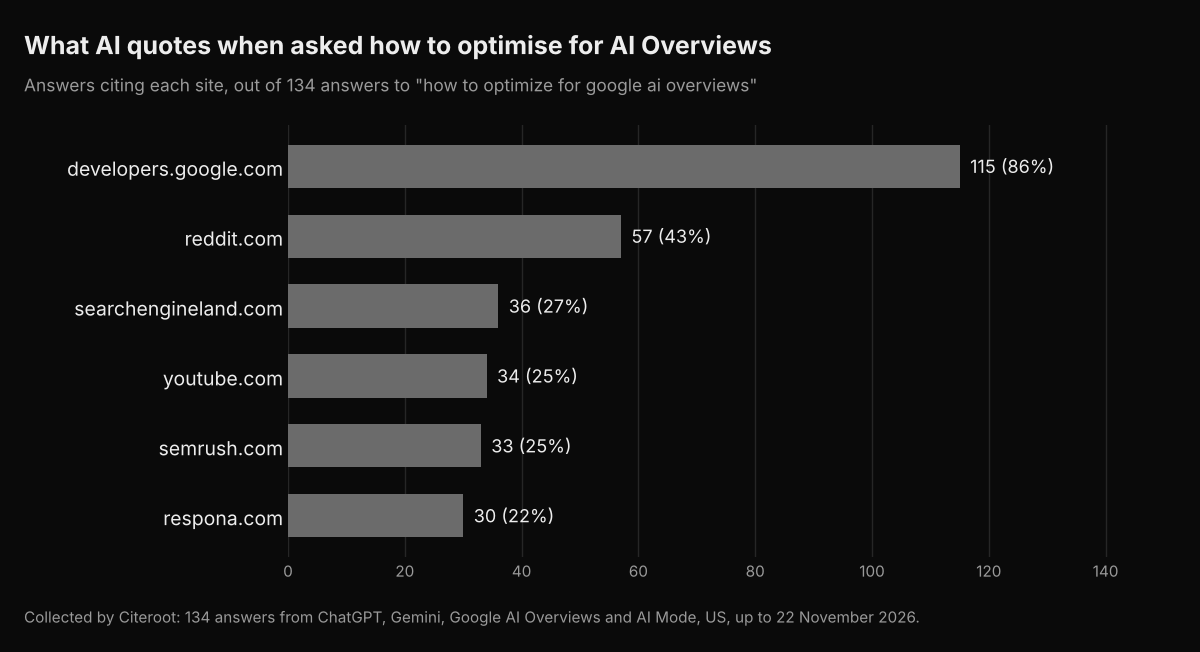
- When asked how to optimise for AI Overviews, AI assistants cited Google's own documentation in 115 of 134 answers (86%).
- Clicks fall when a summary appears: Pew Research Center found users clicked a traditional result in 8% of visits with an AI summary and 15% without, based on 900 US adults in March 2025.
#What does Google say about optimising for AI Overviews?
Google says optimising for AI Overviews is SEO. Its guide to generative AI search, last updated on 10 July 2026, asks whether SEO is still relevant and answers that it is, because its AI features are built on the same core ranking and quality systems as Search.
The same guide is blunt about shortcuts. It says "many suggested 'hacks' aren't effective", that structured data is not required and there is no special schema.org markup for AI features, and that original content people value is likely to matter more over time than any tactic.
Google's separate page on AI features explains how answers are built. AI Overviews and AI Mode may use a "query fan-out" technique, running several related searches across subtopics and data sources, and the models find supporting web pages while the answer is being written. That is why a page that covers the follow-up questions has more chances to be picked.
#How to optimise for Google AI Overviews, step by step
The eight steps below follow Google's own guidance, with what Citeroot's data adds where it applies. Do them in order: there is no point polishing content on a page Google cannot show.
#1. Confirm your pages are eligible
A page can appear as a supporting link only if it is indexed and eligible to be shown in Google Search with a snippet. Check in Search Console that your important pages are indexed, that your site is included in Search generative AI features, and that no nosnippet, max-snippet or noindex rule is limiting them by mistake. Our free AEO page checker shows what AI crawlers see in a page's raw HTML: indexing, headings, the opening, structured data and links.
#2. Answer the question in the first paragraph
Put a complete answer of 40 to 60 words at the top of the page, in sentences that make sense when quoted alone. Then explain. Google's guide does not ask for a format, but an answer that stands alone is easier to lift into a summary, and it is better for the reader who only wants the answer.
#3. Add what other pages do not have
Google's guide recommends first-hand perspectives over recycled summaries. Add your own numbers, a test you ran, a worked example or a photo of the real thing. A page that repeats the top ten results gives the model no reason to cite it over them.
#4. Cover the follow-up questions on the same page
Because AI Overviews can fan one query out into several related searches, cover the questions a careful reader asks next, under headings written in their words. One thorough page usually serves the fan-out better than five thin pages on each sub-question.
#5. Support the text with images and video
Google's guide recommends supporting text with high-quality, relevant images and video. Our data shows why video deserves attention: youtube.com was the most cited site in Google AI Overviews across the markets Citeroot tracks, in 55% of answers with sources.
#6. Get mentioned where AI Overviews already look
AI Overviews quote community and social pages heavily. In Citeroot's data, reddit.com was cited in 29% of AI Overview answers with sources and facebook.com in 26%. Take part honestly in the threads and groups your buyers read, and ask for your business to be included in the lists and reviews already cited for your questions.
#7. Keep local and product details current
Google's guide has a section on local business and ecommerce details. For local questions, keep your Google Business Profile complete and accurate; Google's Business Profile help counts a complete, accurate profile among the things that help a business appear in local results. For products, keep your Merchant Center feed and product pages up to date.
#8. Measure appearances and gaps
Google recommends the Generative AI performance report in Search Console to see how your content performs in these features, and AI feature appearances also count in the Performance report under the Web search type. Search Console shows your own pages, not who was named instead of you, so pair it with a tool that stores the answers themselves.
#What can you ignore?
Google's guide has a section on what you do not need to do, and it rules out several popular tactics. You can skip these.
- llms.txt files. Google says to ignore them for its generative AI search. Our llms.txt article covers what the data shows.
- "Chunking" content or rewriting it for AI. Google says not to rewrite content just for AI systems.
- Special schema for AI. Structured data is not required, and there is no special markup for AI features, though it still helps with rich results.
- Tools that claim to see inside Google. Google tells site owners to be cautious of third-party tools claiming access to internal Google metrics.
- Mass-produced pages. Google links this to its scaled content abuse policy.
#Which sites do Google AI Overviews cite? Our data
Google AI Overviews cite video, community and social sites far more than any single company website. Citeroot collected 864 Google AI Overview answers in the 90 days to 22 November 2026, for 143 questions across 9 markets; 833 of them cited at least one source.
| Site | Answers citing it | Share of answers with sources | Markets it appeared in |
|---|---|---|---|
| youtube.com | 455 | 55% | 7 of 9 |
| reddit.com | 243 | 29% | 6 of 9 |
| facebook.com | 215 | 26% | 9 of 9 |
| instagram.com | 76 | 9% | 8 of 9 |
| quora.com | 59 | 7% | 4 of 9 |
| zapier.com | 35 | 4% | 3 of 9 |
| google.com | 32 | 4% | 7 of 9 |
| tiktok.com | 24 | 3% | 3 of 9 |
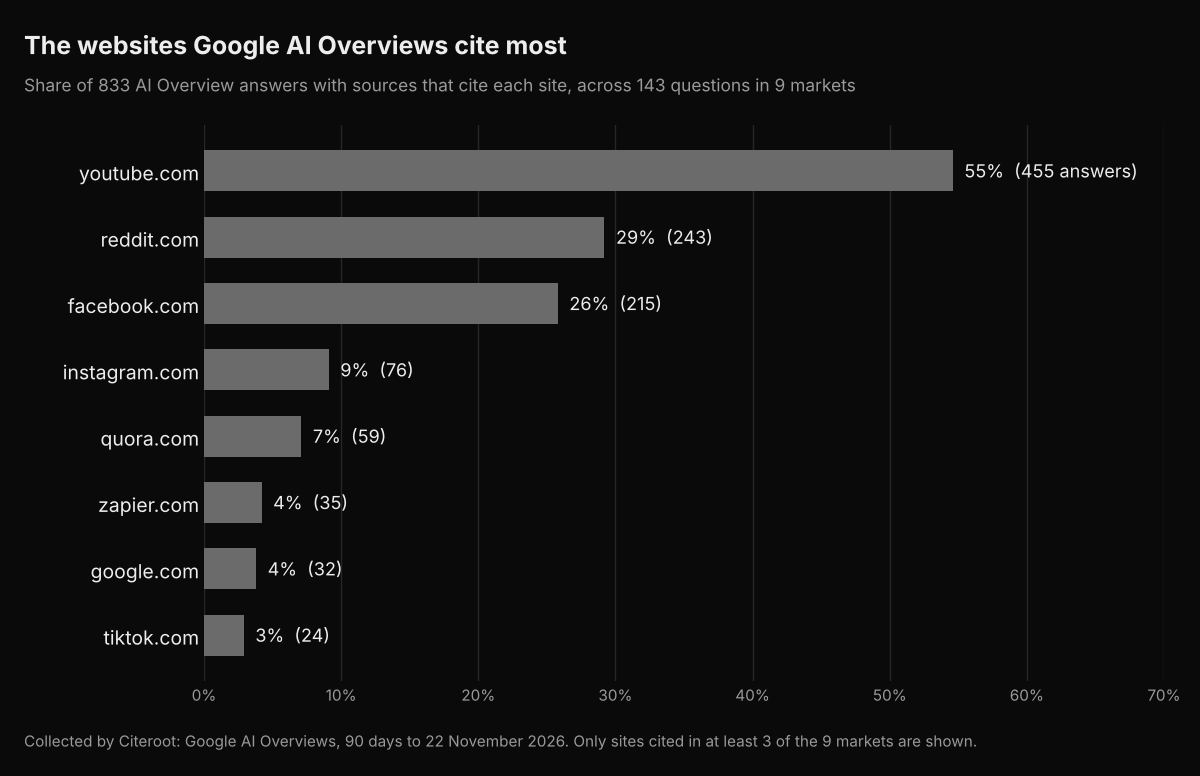
The table shows only sites cited in at least three markets, because a site that appears in one market tells you about that market, not about AI Overviews in general. By kind of site, editorial pages made up 75% of all citations but were spread across 1,338 different sites, while three video sites took 9% of citations between them.
The answers to this very question show the same reliance on primary sources. Citeroot collected 134 answers to "how to optimize for google ai overviews" from ChatGPT, Gemini, Google AI Overviews and AI Mode in the US; Google's own documentation was cited in 115 of them, and the searches the assistants ran nearly all asked for Google Search Central guidance.
#Does appearing in AI Overviews bring clicks?
Appearing in an AI Overview brings fewer clicks than a classic result used to. Pew Research Center tracked the browsing of 900 US adults in March 2025 and found they clicked a traditional search result in 8% of visits when an AI summary appeared, against 15% when it did not, and clicked a link inside the summary in 1% of visits.
That changes how to judge an informational page. Being quoted in the summary puts your name in front of the searcher even when they do not click, so measure whether AI cites and names you, not only the traffic that arrives.
#Common mistakes
- Chasing a format instead of an answer. Google says there is no special markup or structure for AI features; a clear, first-hand answer matters more than any template.
- Blocking the snippet by accident. A
nosnippetor very shortmax-snippetrule also limits what AI features can show. - Writing five thin pages instead of one complete one. Query fan-out rewards a page that answers the follow-up questions too.
- Ignoring video and community sites. YouTube, Reddit and Facebook were the three most cited sites in AI Overviews across the markets Citeroot tracks.
- Judging success by clicks alone. With click rates roughly halved when a summary appears, track citations and mentions as well.
#Where Citeroot fits
Citeroot shows the part Search Console does not: the full AI Overview answer for each of your questions, which businesses it named and which sites it cited. It tracks Google AI Overviews, Google AI Mode, Gemini and ChatGPT on every plan, including Free, and its Source Map lists the sites cited for your questions where you are missing. From the Grow plan, its agent drafts the pages those gaps call for. See the Answer Tracker.
#Frequently asked questions
#Do I need special markup to appear in AI Overviews?
No. Google says structured data is not required for generative AI search and there is no special schema.org markup to add. Structured data that matches the visible page still helps with rich results.
#Do I need to rank on page one to appear in an AI Overview?
Google does not set a ranking threshold. It says its AI features rest on its core ranking and quality systems, and that a page must be indexed and eligible to show with a snippet, so strong pages that already rank well have the best chance.
#How do I know if my site appears in AI Overviews?
Google recommends the Generative AI performance report in Search Console, and AI feature appearances also count in the Performance report under the Web search type. To see the answers themselves and who was named instead, use an AI visibility tool.
#Does llms.txt help with AI Overviews?
No. Google's guide tells site owners to ignore llms.txt files for its generative AI search features.
#Is optimising for AI Mode different?
Google gives the same guidance for both. AI Overviews and AI Mode share the same eligibility rules, and Google says both may use query fan-out, so the steps above apply to AI Mode too.
#Next step
Pick three questions your buyers ask and read today's AI Overview for each, noting who is named and which sites are cited. Citeroot's free plan checks five questions every week on Google AI Overviews, AI Mode, Gemini and ChatGPT. For the wider picture, read our guide to generative engine optimisation and which AI crawlers to allow.
#Sources
- Google Search Central, Optimizing for generative AI search, last updated 10 July 2026.
- Google Search Central, AI features and your website, last updated 10 December 2025.
- Google Business Profile Help, Tips to improve your local ranking on Google.
- Pew Research Center, Google users are less likely to click on links when an AI summary appears in the results, 2025.
- Citeroot answer data: 864 Google AI Overview answers (90 days to 22 November 2026, 143 questions, 9 markets) and 134 answers to one tracked question (ChatGPT, Gemini, Google AI Overviews, AI Mode, US).