On this page
- Key takeaways
- What does an AI search audit cover?
- How to audit your AI search presence, step by step
- 1. Check that AI crawlers can read your site
- 2. Build a fixed set of buyer questions
- 3. Measure named, cited and recommended on each platform
- 4. Split the results by buyer stage
- 5. Map the sources and the gaps
- 6. Check what AI says about you
- 7. Score it, fix the biggest gap, and re-audit
- What our own audit found
- Common mistakes
- Where Citeroot fits
- Frequently asked questions
- How often should I audit my AI search presence?
- How many questions does an AI search audit need?
- Which AI platforms should an audit cover?
- Can I audit my AI search presence for free?
- Next step
- Sources
To audit your company's presence in AI search, check five things in order: whether AI crawlers can read your site, how often ChatGPT, Gemini and Google's AI name, cite and recommend you across 20 to 50 buyer questions, at which buyer stages you appear, which sites are cited instead, and whether the facts AI states about you are right.
By Nadir Ali, founder of Citeroot. Updated 22 November 2026. Platform documentation is cited where it applies; the data comes from an audit Citeroot ran on its own website, and each figure says how many answers, which platforms and which dates.
#Key takeaways
- An AI search audit has five parts: access, visibility, buyer stage, sources and accuracy. Most audits stop at the first two and miss where the real gaps are.
- Measure three results separately on each platform: named, cited (linked) and recommended. In our own audit, AI named Citeroot in 7.8% of 2,257 answers, linked to it in 6.1% and recommended it in 4.2%.
- Split results by buyer stage. On all four platforms, AI named Citeroot in none of the answers to problem, shortlist and constraint questions, the ones asked before a buyer knows any brand.
- A clean technical score does not mean you are visible. Our site health scan scored 99 out of 100 with no AI crawlers blocked, yet unbranded visibility was zero.
- Check accuracy too: in answers collected on 21 November 2026, ChatGPT still described an old free trial from our pricing page.
#What does an AI search audit cover?
An AI search audit is a structured check of how AI assistants find, describe and recommend your company. It covers your own site, the answers themselves and the other websites the answers rely on. The scorecard below is the checklist; the steps after it explain each line.
| Area | What to check | How to check it | A pass looks like |
|---|---|---|---|
| Access | AI crawlers allowed, content in the HTML, pages indexed | robots.txt, a page fetched without JavaScript, Search Console, Bing Webmaster Tools | OAI-SearchBot allowed; key text in the raw HTML; key pages indexed |
| Visibility | Named, cited and recommended, per platform | 20 to 50 buyer questions, 30 or more answers per platform | A rate per platform, with its sample size |
| Buyer stage | Where in the buying journey you appear | Label each question by stage | Some presence before buyers know your name |
| Sources | Sites cited instead of you | Tally the cited domains; list the gaps | A ranked list of pages to pitch or improve |
| Accuracy | What AI says about your prices, features and locations | Ask each assistant what you do and what you cost | No outdated or wrong facts |
#How to audit your AI search presence, step by step
The audit takes about a day by hand for 20 questions, or an hour of reading if a tracker has already collected the answers. Do the steps in order, because each one changes what the next one means.
#1. Check that AI crawlers can read your site
Start with access, because nothing else matters if assistants cannot read you. OpenAI's crawler overview says sites that block OAI-SearchBot "will not be shown in ChatGPT search answers", and Google's guidance on AI features says a page must be indexed and eligible to show a snippet to appear as a supporting link in AI Overviews or AI Mode.
Check your robots.txt with our free AI crawler checker, fetch a key page with JavaScript turned off to see what a crawler sees, and confirm in Search Console and Bing Webmaster Tools that your important pages are indexed. Our AEO page checker shows whether a page opens with a quotable answer.
#2. Build a fixed set of buyer questions
Write 20 to 50 questions a buyer asks before choosing, and label each with its stage: a problem, a request for a shortlist, a constraint such as budget or size, a purchase question or a comparison. Keep most of them free of your brand name, because branded questions are answered from your own site and flatter the result. Our free buyer-prompt builder drafts a balanced set.
#3. Measure named, cited and recommended on each platform
Ask every question on ChatGPT, Gemini, Google AI Overviews and Google AI Mode, in fresh sessions, and record three results per answer: whether you were named, whether your site was linked, and whether you were recommended. Collect at least 30 answers per platform before you trust a rate; in Otterly.AI's study of 252,407 answers, results measured with 10 prompts ranged from 39% to 71%.
Add the platforms' own reports. Google's Search Console generative AI report shows impressions of your pages in AI Overviews and AI Mode, Bing Webmaster Tools' AI Performance report shows citations in Copilot, and OpenAI's Business Hub shows how often ChatGPT referenced your website.
#4. Split the results by buyer stage
A single visibility rate hides where you are missing. Group your results by the stage labels from step 2 and look at the unbranded stages first: if you appear only when a buyer has already typed your name, AI is not bringing you new customers.
#5. Map the sources and the gaps
Copy the sources from every answer and tally the domains. Then mark the gaps: sites cited in answers that name competitors but never you. Third-party articles and lists in that list are the pages to pitch; competitors' own sites and platform documentation show you what kind of page gets cited.
#6. Check what AI says about you
Ask each assistant what your company does, who it is for and what it costs, and compare the answers with your own site. Note every outdated price, missing product or wrong location, and trace each one to the page it came from. Our guide to correcting wrong information in ChatGPT covers the fixes.
#7. Score it, fix the biggest gap, and re-audit
Fill in the scorecard, pick the one area with the biggest gap, and fix that first. Run the same questions again after 28 days and compare like with like; only treat a change as real when it is bigger than the normal run-to-run variation.
#What our own audit found
We ran this audit on Citeroot. The technical side passed: our last site health scan, on 14 October 2026, scored 99 out of 100 across 109 pages, with no AI crawlers blocked by robots.txt. It still flagged 39 pages without a quotable opening paragraph and 65 without question-style sections.
Visibility did not pass. Across 2,257 answers on ChatGPT, Gemini, Google AI Overviews and Google AI Mode in the US, in the 28 days to 22 November 2026, AI named Citeroot in 176 (7.8%), linked to citeroot.app in 138 (6.1%) and recommended it in 94 (4.2%). The stage split shows where the gap is.
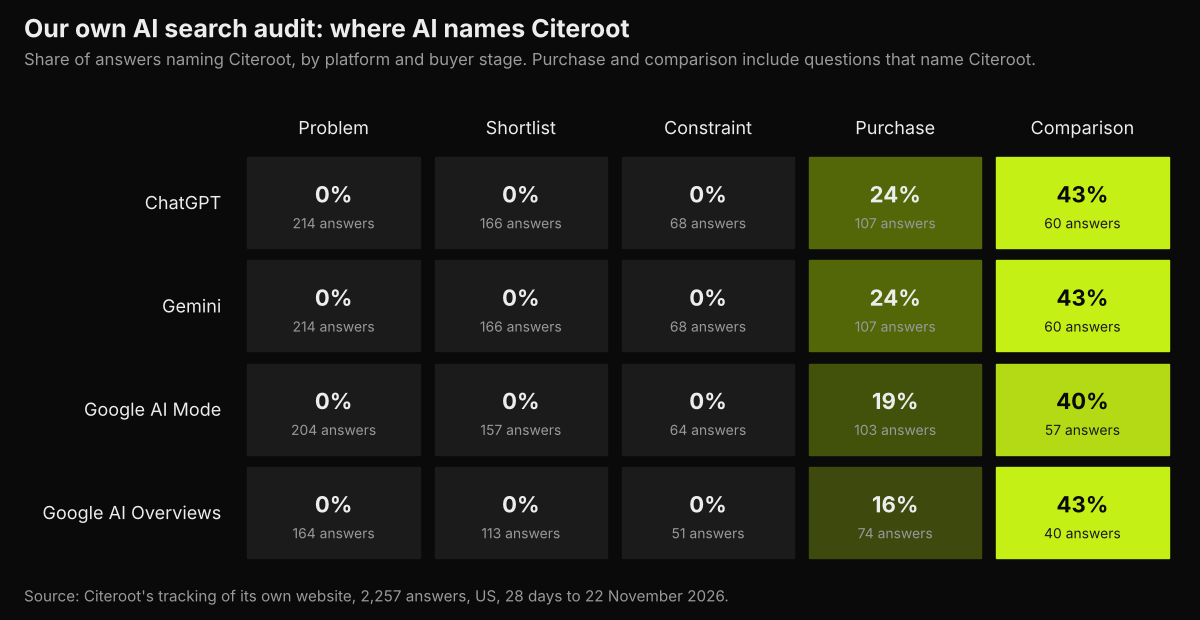
Every platform named Citeroot in 40% to 43% of answers to comparison questions and 16% to 24% of purchase questions, and both groups include questions that name Citeroot. On problem, shortlist and constraint questions, asked before a buyer has a brand in mind, the share was 0% on all four platforms.
The sources and accuracy checks explained why. Over 90 days, zapier.com was cited in 224 answers about our market, 222 of which named a competitor and none of which named Citeroot; technologyadvice.com was cited in 96, 95 of them alongside a competitor. And in ChatGPT answers collected on 21 November 2026, ChatGPT described Citeroot's paid plans as starting with a 14-day free trial, from an old version of our pricing page; the current page offers a 3-day trial of Grow.
The audit points to three jobs, none of them technical: get onto the third-party lists that are cited for our market, publish pages for the unbranded questions, and fix the 39 openings the scan flagged. These figures describe one brand in one market; your own audit will point somewhere else, which is why it is worth running.
#Common mistakes
- Stopping at the technical check. A perfect crawl score says nothing about whether AI recommends you.
- Auditing with branded questions. They make visibility look far higher than it is for new buyers.
- Reporting one blended rate. Split by platform and by stage, or the gaps stay hidden.
- Skipping the sources. The cited domains are where most of the work is.
- Never re-auditing. AI answers change, so an audit is a baseline for the next one, not a verdict.
#Where Citeroot fits
Citeroot runs most of this audit continuously. It checks which of 20 AI crawlers your robots.txt admits and scans your pages for quotable openings and question-style sections, asks your buyer questions on ChatGPT, Gemini, Google AI Overviews and Google AI Mode, records named, cited and recommended separately by platform and stage, and lists the source gaps in its Source Map. The accuracy check still needs a person to read the answers.
#Frequently asked questions
#How often should I audit my AI search presence?
Run a full audit once a quarter and check the main rates monthly. Re-run the relevant steps after any big change, such as a new pricing page or a site migration.
#How many questions does an AI search audit need?
Twenty to 50 buyer questions, with at least 30 answers per platform, give rates you can compare over time. Fewer than that and a month's change is usually noise.
#Which AI platforms should an audit cover?
At least ChatGPT and Google's AI Overviews, plus Gemini and AI Mode if your buyers use Google heavily, and Copilot through Bing Webmaster Tools if your buyers work in Microsoft products.
#Can I audit my AI search presence for free?
Yes. Run the questions by hand, use the free reports from Google Search Console, Bing Webmaster Tools and OpenAI's Business Hub, and use free checkers for crawler access. Citeroot's free plan also tracks five questions a week on four platforms.
#Next step
Copy the scorecard above, run step 1 today and steps 2 and 3 this week, and fill in each line with a number and its sample size. To have the answers collected and split by platform and stage for you, start Citeroot's free plan, and read our guide to improving brand visibility in ChatGPT for what to do with the gaps.
#Sources
- OpenAI, Overview of OpenAI crawlers, read 22 November 2026.
- Google Search Central, AI features and your website, read 22 November 2026.
- Google Search Central Blog, Introducing Search Generative AI performance reports in Search Console, 3 June 2026.
- Microsoft Bing, Introducing AI Performance in Bing Webmaster Tools Public Preview, February 2026.
- Otterly.AI, We measured how stable AI citations and brand mentions really are, September 2026.
- Citeroot data: site health scan of citeroot.app (14 October 2026, 109 pages), 2,257 answers on four AI platforms (US, 28 days to 22 November 2026) and 2,914 answers for source gaps (90 days to 22 November 2026).