On this page
- Key takeaways
- What does AI visibility mean?
- How is AI visibility different from SEO?
- How is AI visibility measured?
- What does AI visibility look like in practice? Our data
- What affects AI visibility?
- Common mistakes
- Where Citeroot fits
- Frequently asked questions
- Is AI visibility the same as GEO?
- What is a good AI visibility rate?
- Can I measure AI visibility for free?
- Does AI visibility bring traffic?
- Next step
- Sources
AI visibility is how often AI assistants such as ChatGPT, Gemini and Google's AI Overviews name, cite and recommend your brand when people ask about your category. It is measured by asking a fixed set of buyer questions on each platform, repeatedly, and reporting each result as a rate with its sample size.
By Nadir Ali, founder of Citeroot. Updated 22 November 2026. Published research is cited where it applies; the example data comes from answers Citeroot collected about its own market, and each figure says how many answers, which platforms and which dates.
#Key takeaways
- AI visibility has three layers: being named in an answer, being linked as a source, and being recommended. Each is measured separately.
- It matters because AI answers change what people click. Pew Research Center found users clicked a traditional search result in 8% of visits when an AI summary appeared, against 15% when it did not.
- AI visibility is measured with a panel of buyer questions asked on each platform again and again, because answers change from run to run.
- For one brand, Citeroot, AI named it in 7.8% of 2,257 answers over 28 days, linked to it in 6.1% and recommended it in 4.2%.
- A single blended score hides the gaps. Split by platform and by buyer stage, and keep questions that name you apart from those that do not.
#What does AI visibility mean?
AI visibility is the presence of your brand in the answers AI assistants give. When a buyer asks ChatGPT for the best tool for a job, or Google shows an AI Overview for a local service, the businesses named in that answer are visible and the rest are not, however well their websites rank.
The term covers three results, from weakest to strongest:
- Named: your brand appears in the answer text.
- Cited: the answer links to your website as a source.
- Recommended: the answer presents you as a good choice for the buyer's need.
Visibility matters because the answer often replaces the click. Pew Research Center tracked the browsing of 900 US adults in March 2025 and found they clicked a traditional search result in 8% of visits when an AI summary appeared, against 15% when it did not. A business left out of the summary loses attention it never gets to measure.
#How is AI visibility different from SEO?
AI visibility and SEO overlap but measure different things. SEO is about where your page ranks in a list of links; AI visibility is about whether an assistant mentions, cites and recommends you inside its answer.
| SEO | AI visibility | |
|---|---|---|
| What is measured | Your page's position in search results | Your brand's presence in AI answers |
| Unit | A ranking for a keyword | Named, cited and recommended rates for a question |
| Stability | Rankings change gradually | The same question can give a different answer each time |
| Main sources of data | Search Console, rank trackers | Repeated question panels, platform reports, AI visibility tools |
| What drives it | Your pages and links to them | Your pages, plus what other sites say about you |
The research that named the field, GEO: Generative Engine Optimization (Aggarwal and colleagues, KDD 2024), found that pages which cited sources, quoted experts and added statistics gained 30% to 40% in visibility in AI answers, while keyword stuffing did not help. Good SEO still helps, because AI features cite pages, but it does not guarantee a mention.
#How is AI visibility measured?
AI visibility is measured by sampling, because no assistant publishes a full record of what it says about you. The method has five parts.
- A question panel. Write 20 to 50 questions a buyer asks, most of them without your brand name, and freeze the wording.
- Platforms. Ask each question on the assistants your buyers use, commonly ChatGPT, Gemini, Google AI Overviews and Google AI Mode.
- Repetition. Ask the panel on a schedule, because answers change. In Otterly.AI's study of 252,407 answers, results measured with 10 prompts ranged from 39% to 71%, against 51% to 60% with 100 prompts.
- Coding. For each answer, record named, cited and recommended, your position, and which competitors appeared.
- Rates with ranges. Report each result as a rate, such as "named in 52 of 615 answers (8%)", with a 95% range, and compare like-for-like periods.
The platforms add their own partial reports. Google Search Console's generative AI report counts impressions of your pages in AI Overviews and AI Mode, and OpenAI's Business Hub counts how often ChatGPT referenced your website; neither shows competitors or the answers themselves.
#What does AI visibility look like in practice? Our data
Here is AI visibility measured for one brand, Citeroot, on four platforms. In the 28 days to 22 November 2026, Citeroot collected 2,257 answers about its own market in the US.
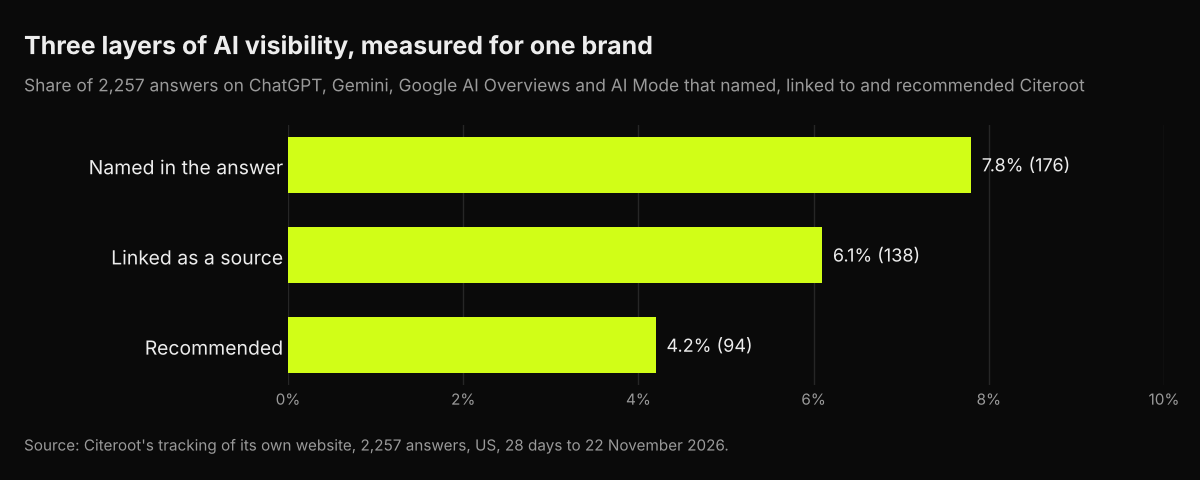
Each layer is smaller than the one before: AI named Citeroot in 176 answers (7.8%), linked to citeroot.app in 138 (6.1%) and recommended it in 94 (4.2%). The blended numbers also hide two splits. By platform, ChatGPT recommended Citeroot in 7% of its answers but Google AI Overviews in 2%. By buyer stage, every platform named Citeroot in 40% to 43% of answers to comparison questions, some of which name Citeroot, and in none of the answers to problem, shortlist and constraint questions.
These are one brand's figures in one market, not a benchmark. They show why AI visibility is reported as several numbers rather than one score.
#What affects AI visibility?
Four things move AI visibility, and each has its own guide.
- Access: whether AI crawlers can read your pages. See why brands go missing from ChatGPT.
- Your own pages: whether they answer buyer questions directly, with evidence. See how to improve brand visibility in ChatGPT.
- Other sites: whether the articles, lists and forums AI cites mention you. See how to get cited by AI assistants.
- Consistency: whether your name, prices and description agree everywhere AI looks.
#Common mistakes
- Reporting one score. A blended number hides the platform and stage where you are missing.
- Counting branded questions. Questions that name you are answered from your own site and inflate every rate.
- Treating a mention as a recommendation. Being listed is not being chosen.
- Trusting small samples. With a handful of questions, a week's change is usually noise.
- Ignoring accuracy. Being named with an old price or the wrong audience can cost you the buyer.
#Where Citeroot fits
Citeroot is an AI visibility tool. It asks your buyer questions on ChatGPT, Gemini, Google AI Overviews and Google AI Mode on a schedule, records named, cited and recommended separately, splits them by platform and buyer stage, and gives each rate with its range, which is how the figures above were produced. See the Answer Tracker.
#Frequently asked questions
#Is AI visibility the same as GEO?
They are related. AI visibility is the result you measure; generative engine optimisation, or GEO, is the work of improving it, such as making pages easier for AI to cite and earning mentions on the sites it trusts.
#What is a good AI visibility rate?
It depends on your category and how crowded it is. Compare yourself with the brands named most for the same questions, and track your own trend over time, rather than aiming for a fixed number.
#Can I measure AI visibility for free?
Yes. Ask 20 buyer questions by hand each month on each platform and record the results, and use the free reports in Google Search Console and OpenAI's Business Hub. Citeroot's free plan also tracks five questions a week on four platforms.
#Does AI visibility bring traffic?
Sometimes. A citation can send a click, and ChatGPT tags its visits with utm_source=chatgpt.com, but many people read the answer and never click. Measure visibility and visits side by side.
#Next step
Write 20 questions your buyers ask and run five of them on ChatGPT and Google today, noting whether you are named, linked and recommended. For the full method, read our guide to measuring LLM brand awareness, or start Citeroot's free plan to have the answers collected for you.
#Sources
- Pew Research Center, Google users are less likely to click on links when an AI summary appears in the results, July 2025.
- Aggarwal and colleagues, GEO: Generative Engine Optimization, KDD 2024.
- Otterly.AI, We measured how stable AI citations and brand mentions really are, September 2026.
- Citeroot answer data: 2,257 answers about Citeroot's own market on ChatGPT, Gemini, Google AI Overviews and Google AI Mode (US, 28 days to 22 November 2026).